
For the last few decades there has been a growing interest in applicable lead free materials [1]. Due to environmental concerns the lead free piezoelectric material research has grown significantly. As most commercially viable piezoelectric materials with lead have great piezoelectric constant and can in a broad temperature range, the aim of this research is to improve dielectric and piezoelectric properties in lead free solid solutions.
Nanocomposite ceramics have been making a breakthrough in search for piezoelectric materials. In this case the material is a "core-shell" type nanocomposite ceramic that consists of a BT-BMT crystallites cores which are coated in a BT shell.
BT-BMT/BT "core/shell" composites were prepared in two steps: the BT-BMT solid solution core was mixed with TiO2 crystallites in a high pressure compressor into cylindrical shape pellets [2], [3] and then submerged into barium hydroxide solution at 175 °C for solvothermal solidification [4], [5].
In this presentation dielectric properties of 0,6BT-0,4BMT “core-shell” will be presented. From figure 1 we can observe an increase of dielectric permittivity between 150K and 380K temperatures. At 380K the real part of the dielectric permittivity reaches a peak point from which the dielectric permittivity drops. This sudden decrease could be interpreted as a structural transition since the composite consists of BT-BMT and BT crystallites.
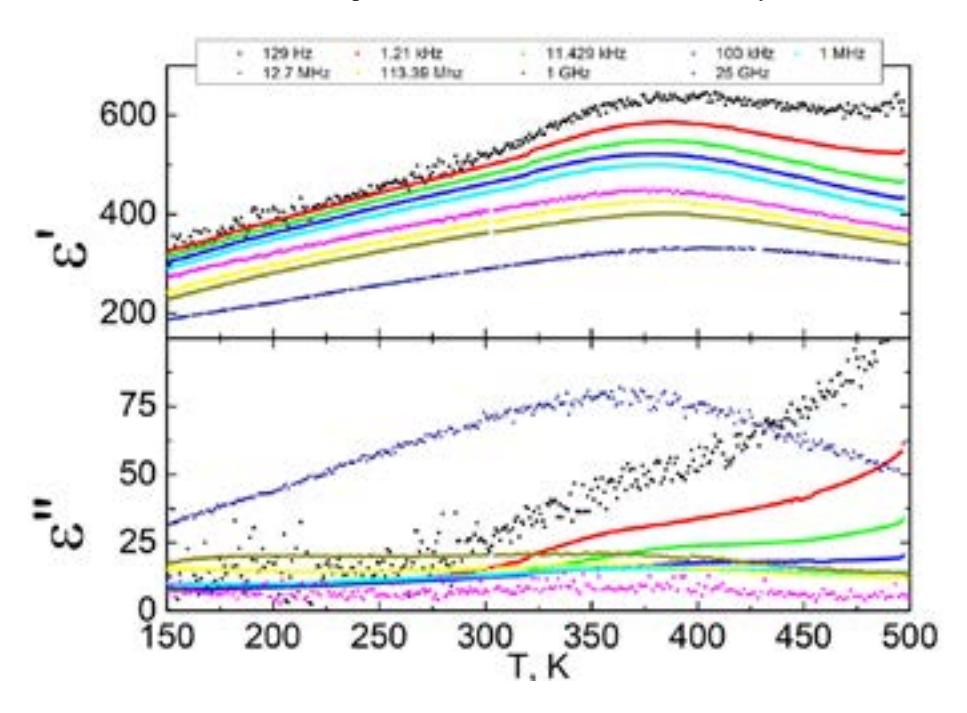
In the poster presentation further investigation would be presented as the 0,6BT-0,4BMT composite would be compared to 0,7BT-0,3BMT composite.