Fluorescent nanomaterials have attracted the interest of researchers in many science fields such as sensing [1], photonics [2] and biological applications [3]. In particular, noble metal nanoclusters (MNCs) have very bright fluorescence emission depending mainly on the dimension of the clusters. This optical feature, not present for metal nanoparticles with diameter larger than few nanometers is due to quantum confinement of electrons within of discrete energy levels in the molecular-like density of states (DOS) of the MNCs [4].
The environmental poisoning is an important and strategic topic for all the human kind. In particular heavy meal ions contamination is very dangerous since they are not biodegradable and can be accumulated in the soil and in the water, coming up to us directly by food and water. The exposure to heavy metal ions can create disease and pathology [5]. For these reasons, simple investigation methods such as the optical ones based on the change of optical characteristics (absorption or fluorescence) in presence of heavy metal ions are highly desirable.
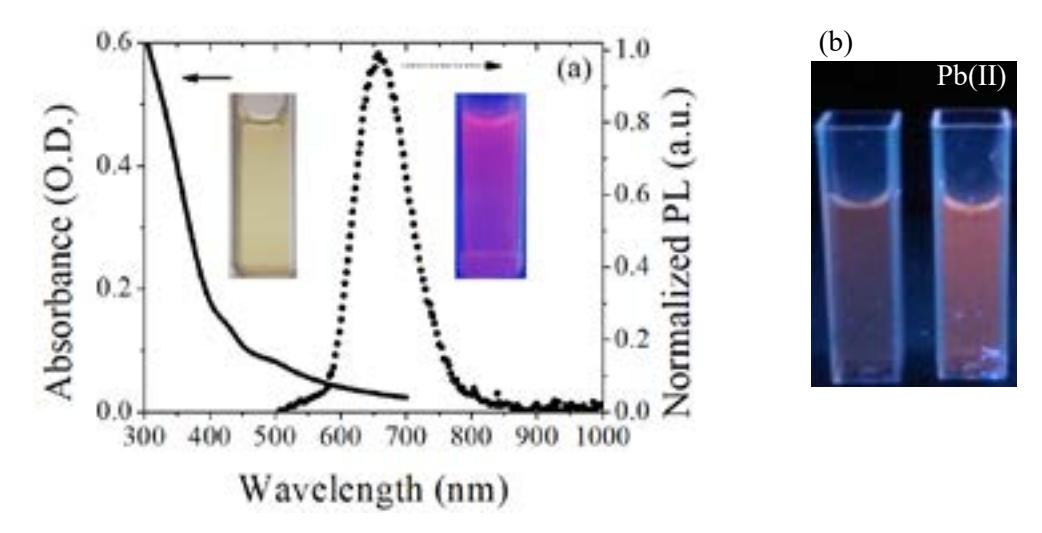
In the present study, we synthesized two different silver nanoclusters (AgNCs) systems in water solution. AgNCs stabilized with lipoic acid (LA) and AgNCs capped with Poly (methacrylic) acid (PMAA). Concerning the synthesis, in both cases, we mixed the aqueous solution of the capping agent with the solution of Ag+ (precursor salt AgNO3). We used chemical reduction to convert Ag+ to Ag(0) using sodium borohydride (NaBH4) for the first system and photochemical approach, using an intense UV radiation, to promote the reduction of Ag+ in the second case. Both AgNCs systems were characterized using absorption and fluorescence spectroscopy. Figure 1(a) shows the absorption spectrum in the UV-Vis range of AgNCs stabilized with LA (solid line) and photoluminescence emission (dotted curve) of the same solution. The inserts are photographs of the solution under white light (left side) and UV light (right side). The red fluorescence is clearly visible by naked eye. We also observed the shape and the dimensionality of the two systems through Transmission Electron Microscopy (TEM). Finally, we tested the sensitivity of both AgNCs systems to several heavy metal ions, monitoring the fluorescence emission with and without heavy metal ions. The final aim is to produce a set of different optical devices able to determine the presence of heavy metal ions in an unambiguously way. The Figure 1(b) shows a photograph of the fluorescence of two cuvettes under UV lamp. The left side cuvette contains AgNCs capped with PMAA solution without any contaminants, while the right side cuvette contains the cluster solution with Pb(II) as contaminant, in the latter case an enhancement of the fluorescence intensity is clearly visible.