Spectroscopic methods are extremely important in physics. The information obtained by multi-pulse spectroscopy methods that allow to observe fast processes in molecular aggregates, often depend on intensity of the impulse with which they are probed.
Exciton-exciton annihilation process is one of the processes that can be observed at higher pulses intensities. The annihilation is the process when two nearby excitations occupy the same site and create a short lived double excited state, which quickly relaxes non radiationally to a single excited state. Thus effectively it is a processes in which two excitation quickly decay to a single excitation.
The exciton annihilation can be observed in pump-probe spectra. To calculate these spectra we will use nonlinear exciton equations(NEE)[1, 2]. Unlike in other method these equations do not require solving eigenvalue equations, equations can be written in site basis. A system of differential equations is numerically propagated for creation and annihilation operators. This allows an arbitrary processes be easily included into these equations. Often methods electric field is assumed to be weak and a perturbation series is made according to it. In NEE equations electric field is included explicitly. This allows to simulate experiments where excitation field has an arbitrary envelope.
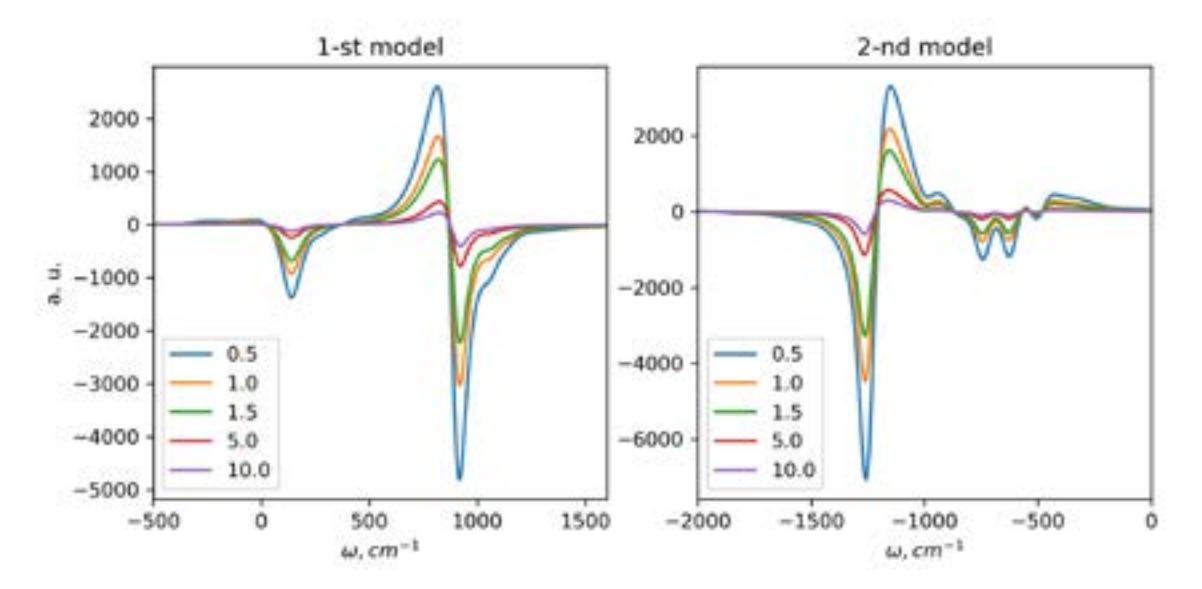
NEE equations were applied to model a cylindrical aggregate. There are plenty of measured spectra[3] for these type of aggregates. Two models for cylindrical aggregate were studied which differ in transition dipole moments orientations. Calculated Pump-probe spectra are shown in figure 1. The first model is similar to H type aggregate and second to J type, the general shape is similar to measured spectra of these type of aggregate. Inclusion of nonlinear terms into equations produces a non exponential decay in calculated spectra, which reflects the exciton annihilation process.