Lipases and esterases from Geobacillus bacteria are enzymes possesing industrially attractive characteristics such as activity in wide temperature, pH, substrate range, stability in organic solvents [1,2]. These enzymes are involved in organic chemistry, food, pharmaceutic and many other industries. Obtaining highly active, stable and, most importantly, low-cost lipolytic enzymes is one of the principal research objects.
Protein engineering is probably the main strategy, allowing us to develope enzymes which have ideal properties for certain bioprocess [3]. One of the most rapidly evolving fields is the design of multifunctional chimeric proteins [4]. Fusing two or more protein domains may lead to increased bioactivities or produced new functional combinations with an expanded range of biotechnological and (bio)pharmaceutical applications [5]. However, the remaining question is whether both fused domains retain their activity. The answer would help to model the structure of novel bifunctional proteins as biocatalyzers for cascade reactions.
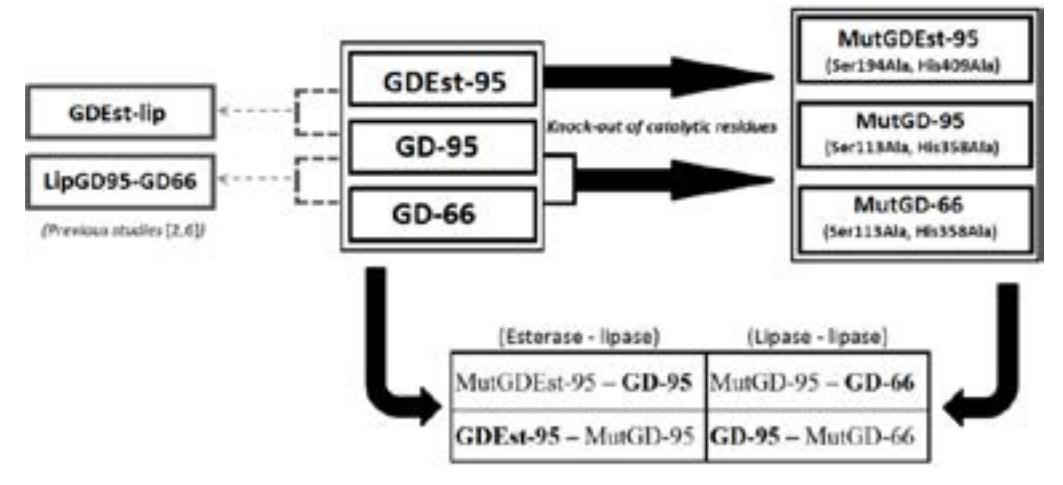
In order to find the solution, we re-designed in previous studies characterised GDEst-lip and LipGD95-GD66 chimeric proteins [2,6]. Geobacillus lipases (GD-95 and GD-66) together with esterase (GDEst-95) were chosen as fusion partners and alanine mutagenesis for knocking-out amino acids in the active sites was applied in order to create chimeric protein variants with only one functional active site (Fig. 1). Later the fused genes were cloned into pET-21c(+) vector, expressed in E. coli BL21 (DE3) cells, purified using IMAC methodology and analyzed via SDS-PAGE and zymography methods.
These results may open on to better understanding of the relationship between the structure of chimeric enzymes and their functionality, as well as expanding the knowlegde about genotype and phenotype space of lipolytic enzymes from Geobacillus.