
Polycrystalline bismuth (III) oxide is very well known for its occurrence in $\alpha$, $\beta$, $\gamma$ and $\delta$ phases (Fig. 1), which is widely reported in the literature. Furthermore, Bi2O3 seems to exhibit different properties, according to its crystalline phase, which makes it an exceptionally interesting material from the perspective of science path for solid state matter, along with possible practical applications. In particular, the $\delta$ phase of Bi2O3 exhibits the highest conductivity in high temperature range (1 S/cm at 750 °C) from among all known oxygene ion conductors. However, it is stable only in a narrow temperature range from 730 to 825 °C [1].
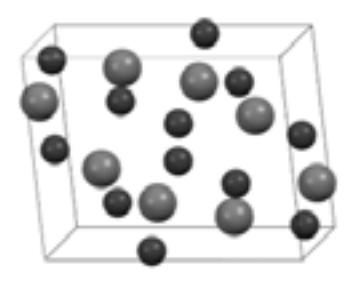
Its very high ionic conductivity has motivated many researchers to look for a method to stabilise this fluorite-type structure to lower temperature. So far the successful strategies to achieve the stabilisation of the delta phase have included doping (e.g. by rare-earth elements [3]) or synthesis in form of thin layers [4]. Our approach to reach the same goal is significantly different. Previous experience with studies on V2O5 has shown that via twin-rollers technique one may obtain this material directly as a nanocomposite. Moreover, different cooling rates applied upon synthesis can significantly alter the properties of the samples [5].
Similarly to V2O5, Bi2O3 remains amoderate glass former. Therefore our idea, presented in this work, is to apply twin–rollers technique in order to obtain bismuth oxide nanocomposites.
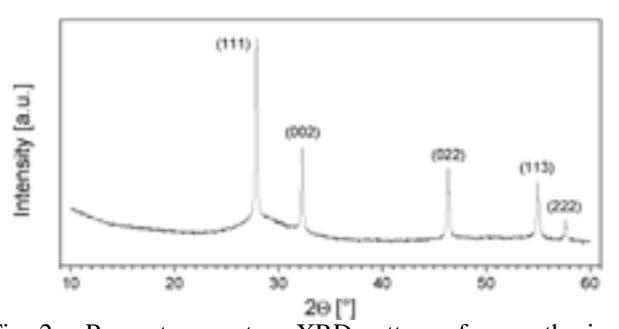
An additional investigation path was to examine, how parameters of the synthesis (e.g. cooling rate) affect thermal stability of as-received materials. X-ray diffraction measurements (XRD) have shown that via twin-rollers technique we succeeded in synthesising nanocomposites in the desired $\delta$-phase, which remained stable at room temperature (Fig. 2). Moreover, studies executed by X-ray diffraction in function of temperature (HT–XRD) revealed that this phase remains stable up to ca. 550 °C, depending on parameters of the synthesis.