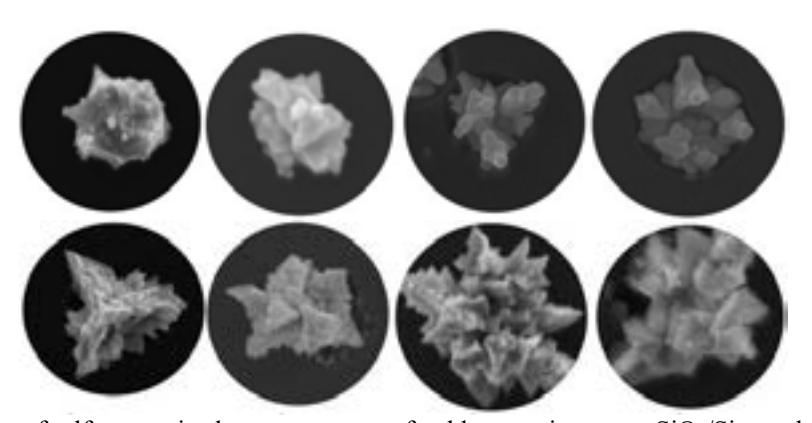
Controlling the morphology of gold nanostructures duaring the formation process is a very important aspect since their optoelectronic and physicochemical properties critically depend on the shape. Man-age the morphology of nanostructures is possible by using of template synthesis method. In this regard, ion-track technology, which allows to form nanostructures with a predetermined geometry is very promising. In this work an ion-track SiO2/Si template was used to form gold nanostructures in pores of silica layer by electroless wet-chemical method. A detailed study of growth mechanisms and factors affecting on the structural and morphological features of gold nanostructures in the pores of the SiO2/Si template was carried out. The influence of pores characteristics (diameters and their surface density), electrolyte composition and deposition modes (time, temperature and acidity) was studied and dependence of crystals morphology on these parameters was demonstrated. Choosing the optimal shape allows to use gold nanostructures for different applications, for example for Surface-enhanced Raman spectroscopy [1-4].