
Notwithstanding the increasing energy efficiency of modern electronic devices, the batteries are still the relevant part and determine the usefulness of the entire device. Nowadays, the majority of used methods for cathode materials production in Li-ion batteries industry require a high temperature (usually a few hundreds of °C) synthesis process [1]. This might significantly increase the cost and complexity of the whole battery production. One of the solution for mentioned disadvantage is applying sol-gel as a low temperature synthesis method. Sol-gel method allows to execute the proper synthesis part at temperatures in the range of 60–80 °C. Moreover, the porosity as well as surface area might be strictly controlled by conducting the process at very specific conditions (e.g. pressure, temperature, concentrations) [2].
Proposed material – lithium iron silicate (Li2FeSiO4) achieves theoretical gravimetric capacity of 332 mAhg-1, what makes it the potential candidate as a cathode material in the batteries. Nevertheless, the material suffers from low value of electronic conductivity. The solution might be well-known method of increasing the conductivity by vanadium doping [3].
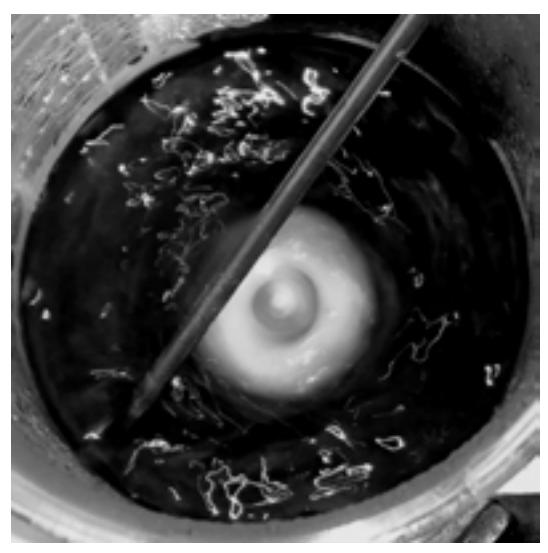
Precursors – LiCH3COO (Aldrich 99.95%), Fe(NO3)3 (Aldrich 99.99%), NH4VO3 (Aldrich 99%) were dissolved in water in stoichiometric proportions, then ethanolic solution of TEOS (Aldrich 99%) was added and aqueous solution of citric acid (Aldrich 99%) was added dropwise. The solution was heated up to 80 °C and under continuous magnetic stirring was left until obtaining hydrogel (dense, high viscosity material). The hydrogel was dried in 80 °C for 48 h to remove water. In this step xerogel was received. The xerogel was grinded in mortar, a part of it was mixed with different carbon sources (sucrose, active carbon) and pelletized. The last step was calcination of the pellets at high temperature in neutral atmosphere of argon flow.
An influence of pH value in precursors solution, calcination temperature and source of added carbon on phase composition of final samples was investigated. Characterization was carried out by X-ray diffractometry (XRD), differential thermal analysis (DTA) and impedance spectroscopy (IS).
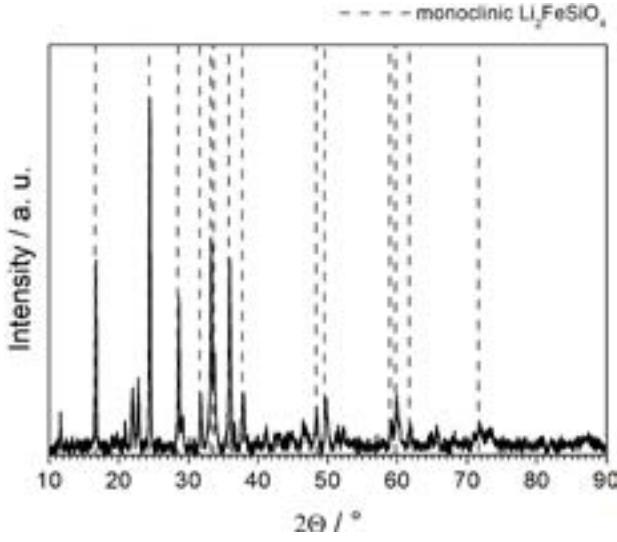
Samples after drying were almost fully amorphous besides small content of LiNO3 phase. Determined optimal conditions were argon atmosphere and calcination temperature equal to 825 °C. Samples annealed at this temperature revealed the highest content of the expected Li2FeSiO4 phase. Calcinations at lower temperatures caused appearing of iron oxides phases in the sample, whereas higher temperatures calcinations ended up with Fe2SiO4 phase in the composition. Processes of calcination conducted in the air (non-neutral atmosphere) were conducive to Li2SiO3 phase crystallization. Furthermore, investigated were calcination in highly reducing atmosphere deriving from active carbon and sucrose. However, such atmosphere caused strong iron reduction in the material. Thermal analysis proved weight loss in a few steps, which had maximums at 215 °C, 337 °C and 584 °C. First two might be attributed to gelating agents (e. g. citric acid) decomposition, whereas the last one is connected with lithium nitrate decay.