
Organic solar cells are a promising type of modern optoelectronic devices with unique possibilities. In particular, lightness, flexibility, semi-transparency and potentially lower cost than silicon based solar cells, makes them competitive in photovoltaic market. However, organic photovoltaics is still a not mature technology with a lot of challenges like short lifespan and low efficiency, which is determined by carrier generation, separation, recombination and other internal physical processes. Investigation techniques for the research of transient characteristics of charge carriers in disordered materials are of high demand for fundamental and applied science. Currently time-resolved research methods are applied most frequently. Notably, Time of Flight (TOF) and Charge Extraction by Linearly Increasing Voltage (CELIV) and number of their variations are the reference techniques for the charge carrier transit time measurements and material investigation. Both of those methods rely on short-pulse photo (electron beam, x-ray etc.) excitation and further observation of the current propagation at constant or linearly increasing bias voltage. Due to the sophisticated structure of disordered materials, the results of investigation strongly depend on measurement conditions and different techniques may provide slightly different results. Therefore, various measurement technique upgrades, modifications and intercombinations are being developed by scientist and material engineers for deeper understanding of undergoing processes.
On the other hand, the principle of Fourier transform states, that time-dependent characteristics can be studied in frequency space and measured characteristics should be the same as in time-domain. Frequency-domain based investigation techniques are widely employed in radioelectronics, photoluminescence decay time and photoconductivity investigation but are not very popular. In this work we present the frequency-domain technique for the research of the transient characteristics of light excited charge carrier in disordered material. The experimental sample of poli(3-hexylthiophene) (P3HT) was made by drop casting method on the glass with fluorine-doped tin oxide (FTO) and silver contacts and zinc-oxide as hole blocking layer. The sample was investigated by frequency-domain technique, which setup and example data are shown in Fig.1. To analyse experimental data a mathematical model was developed, which combines exponential decay of carriers due to recombination and photocurrent in dispersive transport mode (power functions). Mathematical fit was accurate at lower frequencies but not so much at higher ones. The reason is not clear at the moment but probably the Fourier transformation of such a wide frequency (time) range and non-analytical (digital) functions was not accurate enough and can be improved. Nevertheless, the results obtained (e.g. transit times, dispersive coefficient $ \alpha $) were in line with the ones obtained by TOF for the same samples.
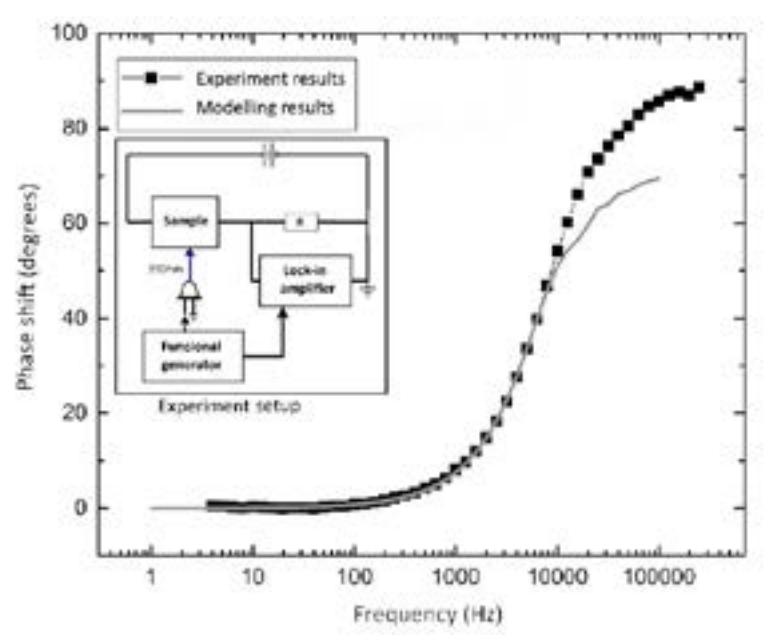
In conclusion we want to emphasize, that frequency-domain investigation methods of charge-carrier transient characteristics has a potential to supplement the traditional time-domain techniques, but appropriate methods and mathematical descriptions have to be developed and validated.