Supercontinuum generation is a phenomenon, when spectrum of a short pulse expands hundreds or thousands of times. The spectrum broadening is usually achieved by launching optical pulses through a nonlinear medium. Photonic crystal fibers (PCFs) can be used as a nonlinear medium for generation of supercontinuum. The use of PCFs for supercontinuum generation enabled its use in many applications such as spectroscopy, optical coherence tomography, frequency metrology, etc. [1-2]. Usually a train of ultrashort pulses is used as pump for supercontinuum generation.
In this study we present experimental results of our investigation of supercontinuum generation in photonic crystal fiber using bursts of two femtosecond pulses. The pump source for supercontinuum generation was a femtosecond Yb:KGW laser oscillator generating 1030 nm wavelength 76 MHz repetition rate and 90 fs duration pulses. A burst of two pulses was created using a setup consisting of a beamsplitter and Brewster-type polarizer. Due to the use of a polarizer, the burst consisted of two orthogonal polarization pulses which were directed to the PCF. For supercontinuum generation, we used a 27.6 cm long polarization-maintaining highly nonlinear PCF. The PCF had core diameter of 1.8 $\pm$ 0.3 μm and average pitch of 1.19 $\pm$ 0.3 μm. The PCF zero group velocity dispersion wavelengths for slow polarization mode are at 807 $\pm$ 2 nm and 1040 $\pm$ 7 nm, whereas for fast polarization mode they are at 838 $\pm$ 2 nm and 1059 $\pm$ 9 nm. During the experiment, the energy ratio between the horizontal and vertical polarization beams was adjusted. While changing the temporal delay of the vertical polarization pulse in the burst with respect to the horizontal polarization pulse in the burst, the aggregated spectra of the generated supercontinuum of both orthogonal polarization modes were measured.
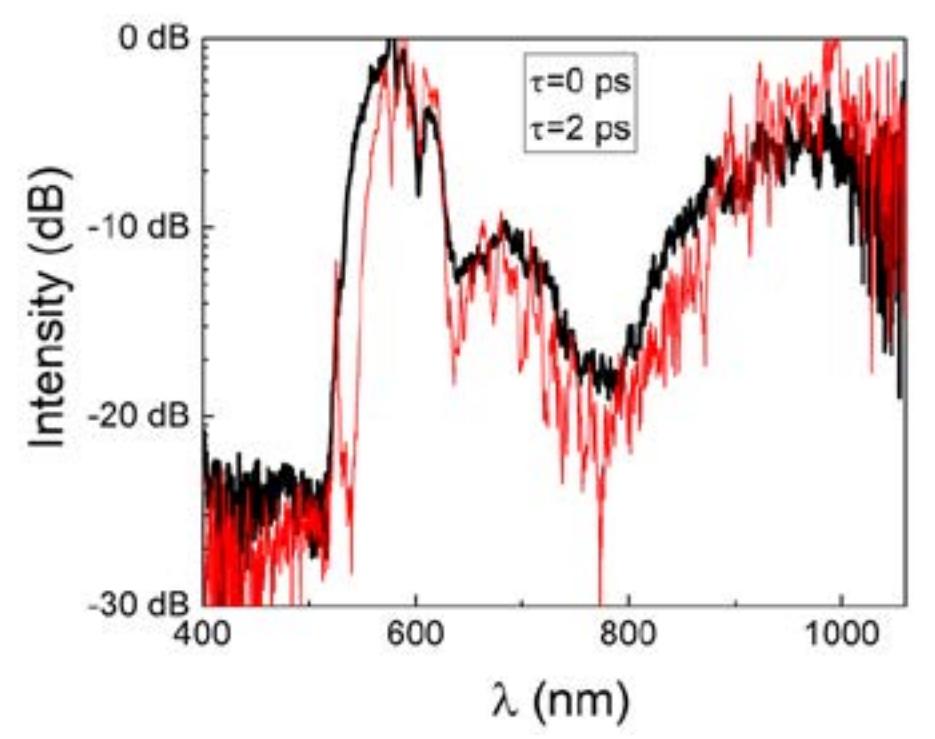
The generated supercontinuum spectrum extended from roughly 510 nm to 1300 nm. Supercontinuum spectra created by orthogonal polarization modes are slightly different due to somewhat different PCF dispersion for orthogonal polarization modes, so the observed spectrum is actually an aggregated spectrum of two supercontinua corresponding to orthogonal polarization modes. We determined that when temporal delay between the pulses in the burst is small, interaction between the pulses in the burst and/or the generated supercontinua corresponding to orthogonal polarization modes occurs resulting in broader aggregated supercontinuum spectrum. When temporal delay between pulses in the burst is zero, the aggregated supercontinuum spectrum is widest (Fig. 2).