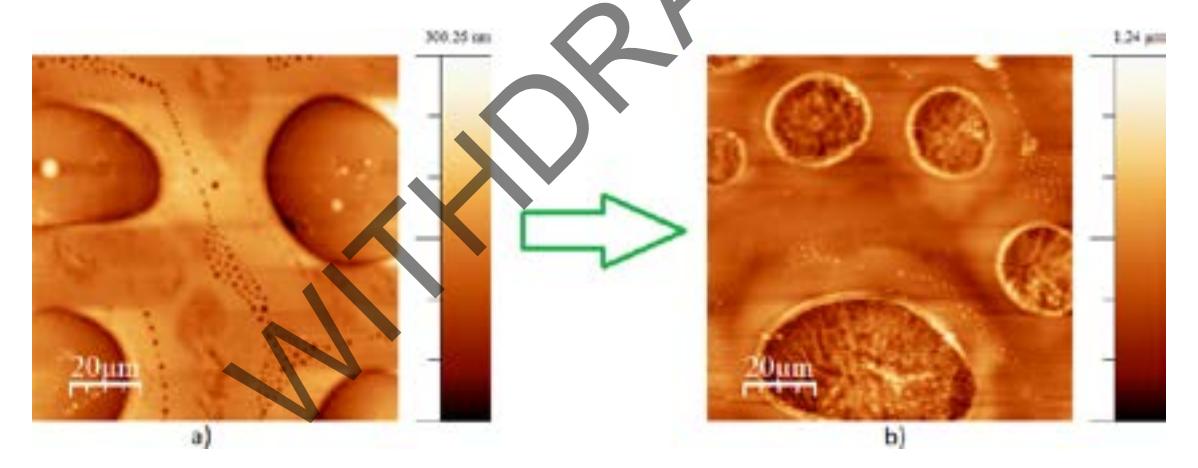
Investigation of using new magnetic materials in high-density memory storage or in molecular spintronics has gained great interest among material scientists. The presented research concerns using a recently reported exciting new material[1] that joins the features of Single Ion Magnets displaying slow magnetic relaxations[2] and polymers that are easy and cheap to process for creating magnetic domains of controllable size in a nonmagnetic medium. The mentioned material is a matrix of poly(4-vinylpyridine) (P4VP) cross-linked by Co (II) salt adsorbed to the polymer from solution - in which slow relaxations of magnetization (that is a certain delay of spin reorientation with respect to changes of external magnetic field useful for e.g. storing bytes of information) are preserved. Using phase separation of P4VP and polystyrene (PS) that has no groups to chemically bind the cobalt salt, through selective adsorption of cobalt bromide CoBr2, magnetic domains of controllable sizes were obtained and investigated. Thin films of this polymer blend were prepared in varying mass ratios from solutions using the spin-casting method. Cobalt bromide adsorption was executed using its solution in a solvent orthogonal for both used polymers (that is, dissolving the salt but not the polymer). Changes in topography observed using Atomic Force Microscopy strongly indicate obtaining paramagnetic domains dispersed in diamagnetic medium, or vice versa, depending on the PS:P4VP mass ratio (see Fig. 1). This is a pioneering step towards applying Single Ion Magnets (till now usually studied in crystal form) in e.g. high-density memory storage using the ease of polymer processing.