Since advantages of organic light emitting diodes (OLEDs) such as a wide viewing angle, fast response, high brightness, low turn-on voltage, etc., they are great candidates for flexible large area lightings and displays. To reach high external quantum efficiencies of OLEDs, emitters exhibiting thermally activated delayed fluorescence (TADF) were incorporated in device structures [1]. These TADF emitters are characterized by ability of light-emitting harvesting of singlet and triplet excitons allowing to reach internal quantum efficiency of 100 % in the best cases. That is practically not possible without appropriate hosts for the chosen emitters. It was recently shown that exciplex-forming solid-state mixtures of donating and accepting organic semiconductors are efficient hosts for the TADF emitters resulting in extremely low turn-on voltages (~2.1 V) and high power efficiency of TADF OLEDs [2]. However, number of efficient exciplex-forming hosts is very limited.
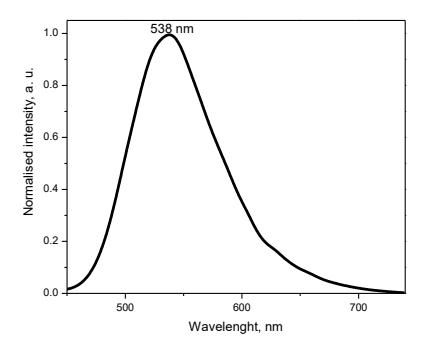
In this work, highly efficient host-guest systems were developed and tested in solution-processed OLEDs. Variety exciplex-forming hosts and TADF emitter (guest) systems were investigated by steady-stay and time-resolved spectroscopy. Among them, the best system included TADF host TCz1:PO-T2T [3] and TADF emitter DAcIPN [4] where TCz1 and PO-T2T are electron-donating 3,6-bis(carbazol-9-yl)-9-(2-ethyl-hexyl)-9H-carbazole and electron-accepting 2,4,6-tris[3-(diphenylphosphinyl) phenyl]-1,3,5-triazine compounds while DAcIPN is 4,6-Di(9,9-dimethylacridan-10-yl) isophthalonitrile, respectively. Electroluminescent properties of this system TCz1:PO-T2T:DAcIPN were tested in OLEDs having structure ITO/PEDOT:PSS/TCz1:PO-T2T:DAcIPN/TSPO1/TBPi/LiF/Al where the hole injection layer is poly(2,3-dihydrothieno-1,4-dioxin)-poly(styrenesulfonate) (PEDOT:PSS), hole blocking and electron transporting layers are diphenyl[4-(triphenylsilyl) phenyl]phosphine oxide (TSPO1) and 2,2',2"-(1,3,5-benzinetriyl)-tris(1-phenyl-1-H-benzimidazole) (TPBi), respectively. Light-emitting layer TCz1:PO-T2T:DAcIPN were spin-coated consisting the ratio of 1:1 of donor TCz1 - acceptor PO-T2T exciplex and 10 wt% of TADF emitter DAcIPN. The fabricated device was characterized by green emission with stable electroluminescence (538 nm) at different voltages (Figure 1). Commision Internationale l'Eclairage (CIE 1931) chromaticity coordinates (x, y) of the green devices was found to be (0.33, 0.58). Proving efficiency of the developed host-guest systems TCz1:PO-T2T:DAcIPN, high maximum brightness of 10500 cd/m2 were obtained for the fabricated solution-processed devices.