
In our research, a reliable biometric authentication system was proposed by means of features identification of human electroencephalograms (EEG) using neural networks.
We took EEG-data from "PhysioNet" database [1] (https://www.physionet.org/pn4/eegmmidb/). This dataset consists of EEG recordings of 109 subjects with 23 trials each with Motor Movement/Imagery tasks, performed with 64-channel BCI2000 EEG system. For authentication system development we used only "opening and closing right and left fist" tasks.
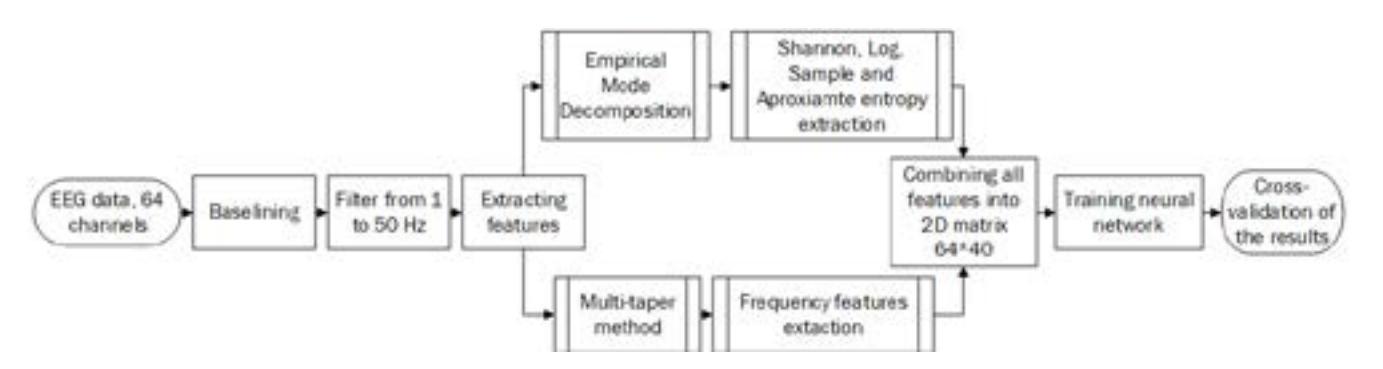
In order to preprocess raw data and extract features, we wrote MATLAB based program. First, we subtracted baseline, for which we used recording of 2-second relaxation before each trial. Then this data was filtered with zero phase delay filter from 1 to 50 Hz.
After that, Empirical Mode Decomposition (EMD) was calculated for each trial and only first 5 intrinsic mode functions (IMFs) were left as the most useful ones. For each IMF Shannon, Log, Sample and Approximate entropies were calculated. Values of these entropies were later used as features for the neural network. Moreover, Spectra were calculated from each trial by Multi-taper method (MTM) in "Chronux" toolbox. Intensity of different rhythms were used as features as well. Finally, for each trial and each subject all features were combined in 2D matrix 64x40 (64 - number of channels, 40 - number of features), and these matrices were later on used as input for the neural network. (Fig.1)
We build three authentication systems: in the first two systems, the input data was a record of one action (opening and closing left or right fist respectively). The input data for the third system was a sequence of two separate actions (opening and closing left and right fist consistently), so that a subject will be authenticated only if he or she will be authenticated by both of these actions.
To recognize each of the actions, a separate neural network with the same architecture was trained. For creation and training neural networks we used "Keras" framework in Python. To obtain the accuracy of each model, 5-fold cross-validation was used. Within each fold, the training sample was normalized within each feature, and accuracy was tested on a test sample, which was normalized using the minimum and maximum values of the training sample.
We got accuracy around 93% for each task, and around 90% for both tasks, but the most interesting fact, that false positive (type II error) is zero for each task and for both tasks as well. (Table 1) Therefore this method is 100% authentication system.
| Right fist | Left fist | Combination of 2 fists | |
|---|---|---|---|
| Type I error, % | 0.15 | 0.13 | 0.2 |
| Type II error, % | 0.0 | 0.0 | 0.0 |