
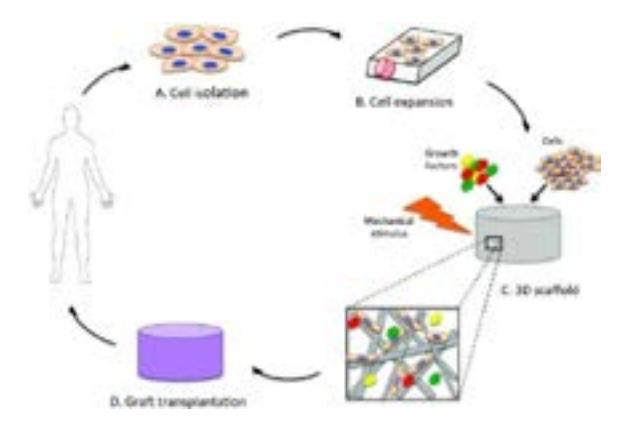
Tissue engineering is a fast-growing field of science that enables the creation of biological tissues. The tissues are grown on a synthetic artificial carcass which is created using 3D printing technology (Fig. 1). It is very important to choose the right materials for the frame, it must be biocompatible, so that the cells could reproduce and functionalize, it must have mechanical strength, be flexible, biodegradable and non-toxic [1]. Poly(dimethylsiloxane) (PDMS) elastomer is one of those biocompatible polymers which is widely used in medicine due to it's properties such as: biocompatibility, gas permeability, non-toxicity, chemical and biological inertness, transparency, and because of it's low cost. However, its use is limited by hydrophobicity which can cause cellular adhesion on the surface to be short-lived, and low mechanical resistance. By improving these features, the ability to use PDMS is significantly enhanced. That's why many strategies have been suggested to enhance hydrophilicity of PDMS [2].
The aim of this work was to obtain biocompatible films from polyesters modified with hydroxyl terminated PDMS. Polyester films were synthesized from azelaic acid, maleic anhydride, diethylene glycol and were chemically modified with hydroxyl terminated PDMS, at various initial molar ratios. Glycidyl methacrylate, (hydroxyethyl)methacrylate and/or buthyl methacrylate were attached to obtained copolymers to form UV-curable product. Crosslinking was initiated by photoinitiator Irgacure 651 and UV light. The films were tested for swelling and solubility in hexane, ethanol and water. To investigate the hydrophilicity of films, a study of humidification angle was performed. The strength of the films was also measured in tensile test.