
High-entropy alloys (HEAs) are presently of growing attention for researches employed both in scientific and engineering fields of activities.High-entropy alloys (HEAs) are promising new class of materials and candidates for many potential applications with high solid-solution strengthening, high strength properties, excellent resistance to high-temperature softening, good ductility, high wear and corrosion resistance at room temperature as well as at high temperature [1, 2]. High homogeneity of HEAs and nanocrystalline structure allows to improve physical and mechanical characteristics. It can be achieved by use mechanical alloying (MA) for synthesis and next sintering under pressure at the low temperatures to maintain the initial HEAs structural state [3].
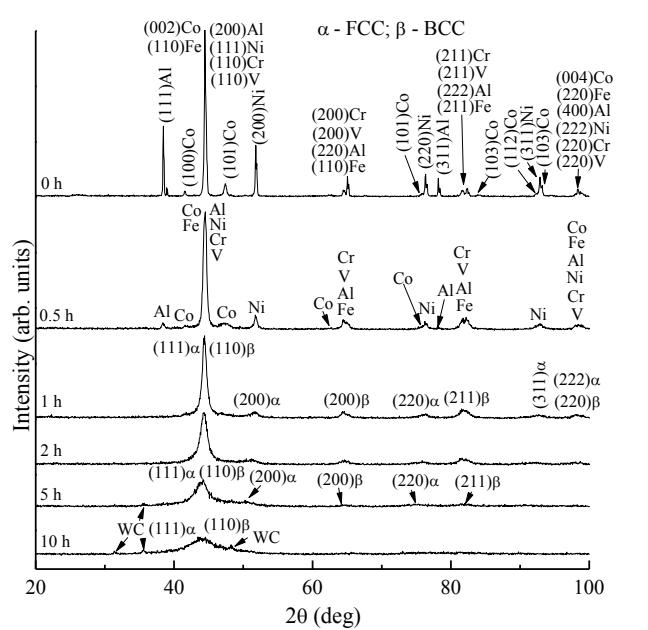
The present study describes the synthesis of nanocrystalline equiatomic AlCoFeCrVNi high-entropy alloy from elemental materials to solid solution phases by mechanical alloying (MA) with following sintering under high pressure and characterized by XRD (X-ray diffractometer Ultima-IV, Rigaku with Cu K\alpha radiation), SEM and mechanical testing. The elemental powders were milled in a planetary ball mill with tungsten carbide grinding media in petroleum. In order to confirm the alloy formation during milling, powder samples were taken out atthe intervals of 0.5, 1, 2, 5 and 10 hours. After the successful MA synthesis of equiatomic nanocrystalline AlCoFeCrVNi HEA powders, the consolidation was carried out at 1200 °C for 60 min in vacuum and at 800 °C for 30 min at a pressure of 5 GPa using hydraulic press DO 044. XRD pattern shown in Fig. 1 reveals the phase formation in AlCoFeCrVNi HEA with milling time. From the XRD results it is clear that the alloy formation is completed after 10 h with the formation of BCC solid solution ($\beta$-phase) along with small volume fraction of the FCC solid solution ($\alpha$-phase).
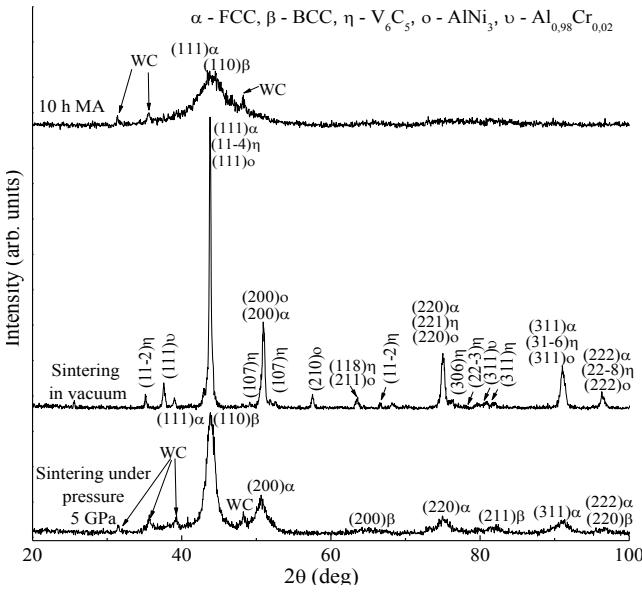
The XRD patterns of the MA powder consolidated by sintering in vacuum and under pressure 5 GPa at 800 °C confirms that the BCC and FCC solid-solutions are metastable. After sintering under pressure the alloy is composed of two solid solutions with FCC and BCC structure and the small volume fraction of tungsten carbide. After sintering under pressure, the AlCoFeCrVNi alloy remains in a nanocrystalline state with a crystallite size about 50 nm, and the porosity of the sample doesn't exceed 1 vol. % and have high microhardness, HV = $11.7\pm1$ GPa After sintering in vacuum the AlCoFeCrVNi HEA is composed of major FCC phase and intermetallic V6C5, AlNi3, and Al0.98Cr0.02 phases. It was found that its microhardness HV = $3.7\pm0.3$ GPa. Such low microhardness of the alloys is a result of the high porosity of the samples after sintering in vacuum.