Photosynthesis starts with the harvesting of sunlight energy by antena pigments from which molecular excitations are transfered to the reaction center [1]. Systems absorption spectra and energy transfer is dependent on pigments arrangement in photosynthetic complex and their interactions with surrounding environment. Even in systems where chlorophylls are the main light harvesters, antenna's composition and arrangement varies widely in nature. This wide variety lets photosynthesis to operate in fluctuating environment conditions.
There is many models to simulate dynamics for energy transfer from light harvesting antenna to reaction center. One of the most used is Redfield relaxation equation [2]. In this equation the energy transfer-relaxation enters via the correlation function of system - bath interaction operators. Correlation function gives us the dynamics of the system in time and defines the memory range in the system - bath feedback process.
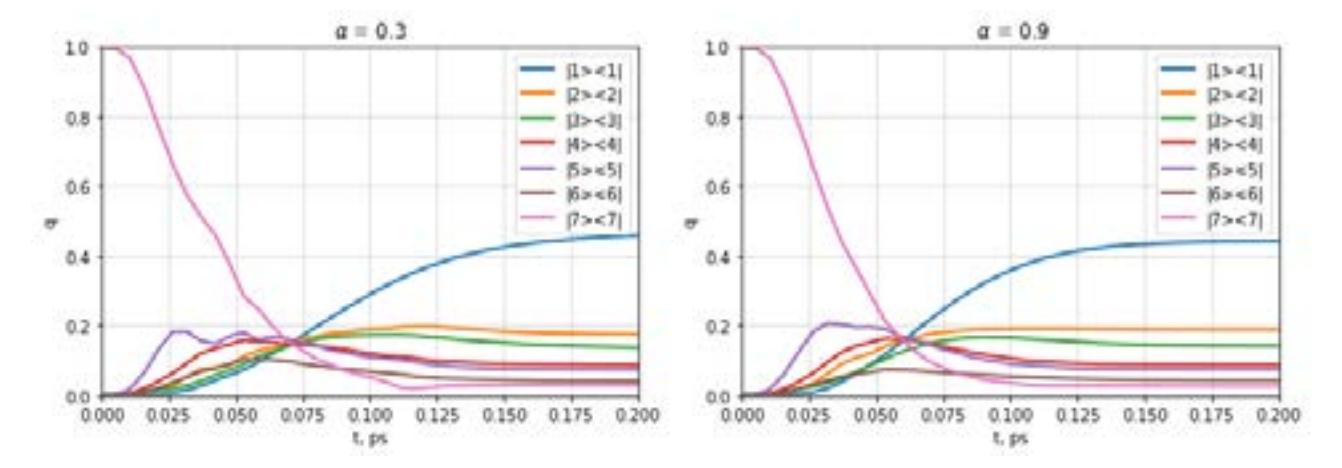
In this work we study the memory effect in excitation dynamics by using the non-Markovian Redfield equation for "long memory" correlation functions that we obtain from fractional Langevin equation [3] .We take a look at Fenna-Matthews-Olson complex dynamics influenced by memory effects. By increasing the memory range, fluctuations become like classical, then the influence of coherence on population dynamics increases (fig. 1). Comparing fractional correlation function and the traditional long memory Drude model, the fractional model gives bigger influence of cohrerences on population dynamics.