Multiferroics are materials in which two or all three of the properties, namely ferroelectricity, ferromagnetism, and ferroelasticity occur in the same phase. This means that they have a spontaneous magnetization that can be reoriented by an an applied magnetic field, a spontaneous polarization that can be reoriented by an applied electric field, and a spontaneous deformation that can be reoriented by an applied stress [1]. The recent interest in magnetoelectric materials has been stimulated by their great potential for future multifunctional device applications and fascinating physics. Bi-containing perovskite-type transition-metal oxide systems are of special interest, since they are considered as the most promising multiferroic materials. In these systems, the ferroelectricity is known to originate from a relative Bi-O displacement resulting from the stereochemical activity of the lone-pair Bi cations [2]. Many of such systems can be synthesized only at special conditions (e.g., under high-pressure). Nevertheless, they are of great interest because of their possible practical applications (e.g., as multiple-state memory elements, field sensors and tuneable magnets).
BiCrO3 was first synthesized by Sugawara et al. in 1968 and reported to be antiferromagnetic below 123 K with a weak parasitic ferromagnetic moment [3]. Despite enormous research efforts, physical properties of this material have not fully been understood and the peculiarities of magnetism and ferroelectricity of BiCrO3 are still debated.
Dielectric response of the high-pressure synthesized BiCrO3 and BiCr0.9Sc0.1O3 ceramics was studied in a temperature range of 40-530 K. The dielectric permittivity was measured in a cooling mode with a rate of 1 K/min. The measurements were performed in two frequency ranges. Between 20 Hz and 1 MHz, capacity and loss tangent were measured using an LCR meter HP-4284A. In the 2 MHz - 3 GHz range, a vector network analyzer Agilent 8714ET in a coaxial line was used.
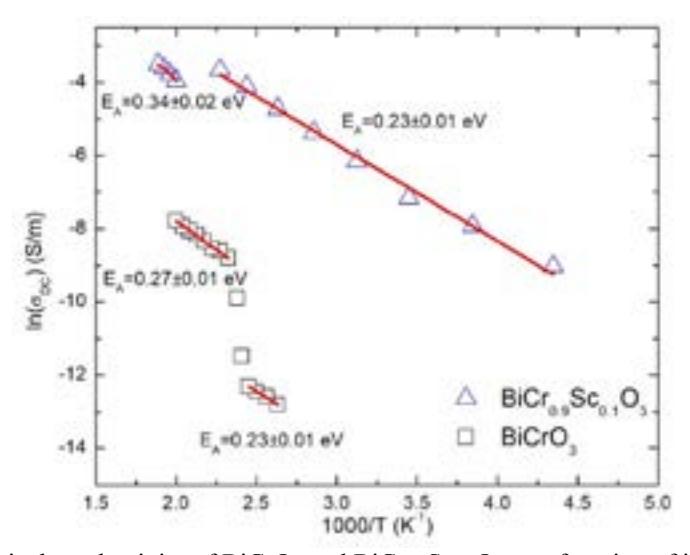
Broad dispersions and considerable dielectric losses were observed for both compositions. Therefore, we decided to investigate their direct current (DC) electrical conductivity. The calculated electrical conductivity was fitted with the Almond – West law, which describes the conductivity behavious rather well. Fig. 1 shows a dependence of DC conductivity on inverse temperature. From these data, using the Arrhenius law we got the activation energy (1):
$$\sigma_{\rm DC} = \sigma_0 \exp\left(\frac{-E_{\rm A}}{kT}\right) \tag{1}$$Activation energy before phase transition in both compounds are comparable ≈0.23 eV, but in paraelectric phase its value increases to 0.27 eV in BiCrO3 and to 0.34 eV in BiCr0.9Sc0.1O3