One-dimensional (1D) lattices are structures where particles (e.g. molecules) are placed in such a way that they can only communicate with two neighbours (e.g. single-walled carbon nanotubes [1]). In these lattices particles can be optically excited and molecular excitons can be generated. The dynamics and relaxation of these excitons can be modelled using multiple methods (Monte Carlo, kinetic equations, etc.).
However, in real experiments on molecular aggregates, sometimes several excitons per aggregate are simultaneously generated, especially at higher excitation intensities. When that happens exciton-exciton annihilation becomes very important. During this process, two or more excitons reach the same molecule, the resulting approximately doubly excited state relatively fast relaxes to a single excitation state, while the lost electronic energy is dissipated as heat. In small molecular system, when excitation migration through the aggregate can be neglected, the singlet-singlet annihilation can be modelled by solving the corresponding kinetic equations [1,2]. However, for larger aggregates, excitation diffusion must be taken into accounts, which significantly complicates modelling of the exciton dynamics.
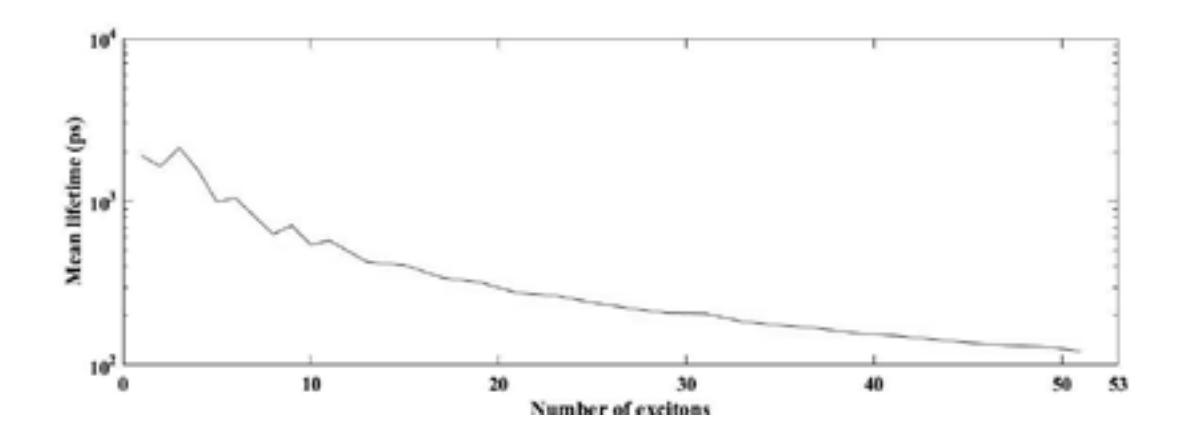
In this work, we performed Monte Carlo simulations on the dynamics of multiple excitons in a 1D lattice. To produce the random walk of each exciton at each time step we generated random numbers between zero and one. We then compared these numbers to the probabilities of as single exciton's movement (move to the left; move to the right or stay in the previous position). After the random walk of a time step, we then checked if any molecule had more than one exxciton. If it did, then it had it's exciton number reduced to one and another time step began. Using this model, we generated multiple systems with varying numbers of excitons and eveluated the mean excitation lifetimes of each system. The obtained result is shown in Fig. 1.