
Solar simulator is an artificial device that closely resembles the Solar irradiance for the purpose of testing photovoltaic devices in a controlled environment. Solar simulators are usually made using Xenon arc lamps. Considering the inefficiency of Xenon arc lamps [1], light emitting-diodes (LEDs) have recently been used in research laboratories to construct solar simulators, and offer promise in the future for energy-efficient production of spectrally tailored artificial sunlight [2]. There are three main aspects that a Solar simulator should comply with, defined in the IEC 60904-9 Ed. 2.0 [3] international standard.
The IEC 60904-9 Ed. 2.0 international standard defines the classifications of solar simulators for use in indoor measurements of terrestrial photovoltaic devices; solar simulators are classified as corresponding to A, B or C class for each of the three categories based on criteria of spectral distribution match, irradiance non-uniformity on the test plane and temporal instability. It also provides the required methodologies for determining the rating achieved by a solar simulator in each of these categories.
The purpose of this work was to design a Solar simulator, that would satisfy AAA class requirements of IEC 60904-9 Ed. 2.0 for at least 13×13 cm2 illuminated area, using high-power light-emitting diodes with a square tubular mirror system. Such uniformly illuminated area would be sufficient for testing solar cells of several standard industrial sizes, based on wafers of up to five inches dimensions. Computer simulations of irradiance from the solar simulators were performed to optimize the design of the simulator using complex LED placement patterns and various optical solutions. Several designs were simulated: one with individual reflectors on white LED arrays, one with external mirrors reflection coefficient of 0.8 and one employing individual reflectors on color LEDs and external mirrors with reflection coefficient of 0.9. One of the best results is presented in (Fig 1 (a)). A prototype solar simulator was built and its specifications were measured (Fig. 1 (b)).
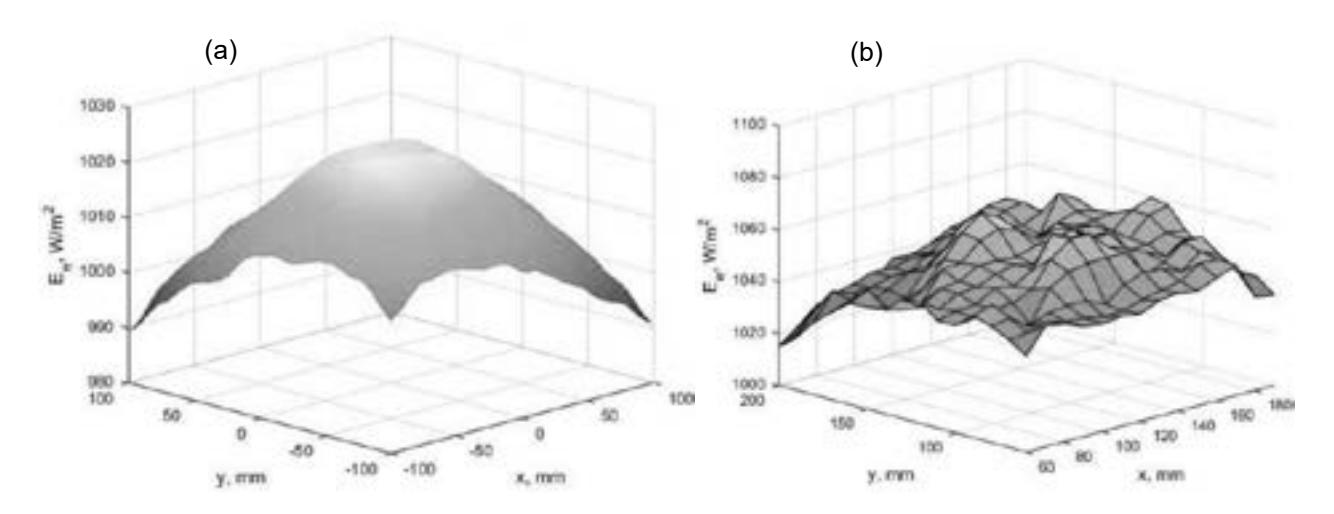
The developed Solar simulator satisfies A class irradiance uniformity requirements according to IEC 60904-9 Ed. 2.0 standard for 14×15 cm2 area. Only 22 light-emitting diodes were used to achieve this result: 2 units of Bridgelux high-power white LEDs, in conjunction with LedEngin series 2 units of 450 nanometer LEDs, 2 units of 660 nanometer LEDs, 6 units of 740 nanometer LEDs, 4 units of 850 nanometer LEDs and 6 units of 940 nanometer LEDs. In addition, A class spectrum requirements are also satisfied in all points of the investigated area as will be demonstrated during the presentation. Inherent properties and long lifetime of LED arrays also ensures A class requirements for irradiance stability, thus completing the set of properties of AAA class solar simulator.