
When various objects go through operating conditions such as stress, temperature changes, vibrations sooner or later defects such as cracks develop which will eventually cause structural failure. For the avoidance of catastrophe, objects have to be inspected periodically. It can be achieved with various inspection methods such as x-rays or ultrasonic inspection[1]. The examination method usually depends on budget and how critical structure is. Relative cheap method is ultrasonic inspection with phased arrays, because of transducer array structure is possible to change focus point electronically or in physical terms is a sound energy accumulation for chosen area with purpose to listen to stronger echo, it is an actual problem with bent object because of refraction it can form areas where very little energy is delivered. With the processing of echo signals is possible to decide the structure condition and even to map its interior.
The main aim of ultrasonic inspection is to effective transfer energy into the designated point for the purpose to be reflected in order to interpret it correctly. For this reason, acoustic paths must be modeled or calculated explicitly, when a surface structure is known beforehand there are readily prepared methods, but if there no such information then the surface needs to be determined and is an active research problem. It can be solved using the similar ultrasonic methods as for inspection, albeit usually, algorithms assumes defects are point scatters. After surface determination, collected information need to be used for further processing. It can be done by aligning (delaying) signals[2] and doing some mathematical operation for example summing, correlation or other, this operation commonly is called synthetic aperture focusing (SAFT) classical focusing in the time domain can be expressed following:
$$y(k) = \sum_{i=1}^{M} x_i(\delta_{k,i})\tag{1}$$Here $y(k)$ – region intensity, $M$ – active aperture (recorded elements), $x_i$ – recorded signal, $\delta_{k,i}$ – a signal model for point $k$. The focusing work by assumption if there is a response from object boundary or defect signals will make constructive interference if there no response they will create noise or cancel each other. There are already done much research for path calculation when there are direct visibility, or object surface boundary is a straight line, but solving imaging problem with curved surfaces is not a trivial problem[3]. Primary, the constraint is storage space and time, for example using 128 channel transducer with 10000 samples of data and firing element sequentially; then collecting data can reach in gigabytes storage space, of course, it can be reduced using plane wave imaging. Plane wave imaging is technique when all transducer element is firing same time; it reduces collected data. The secondary goal is to reduce processing time, even using powerful GPU it will take minutes to make a complete inspection image. For example graphically problem and solution can be shown in the following figure:
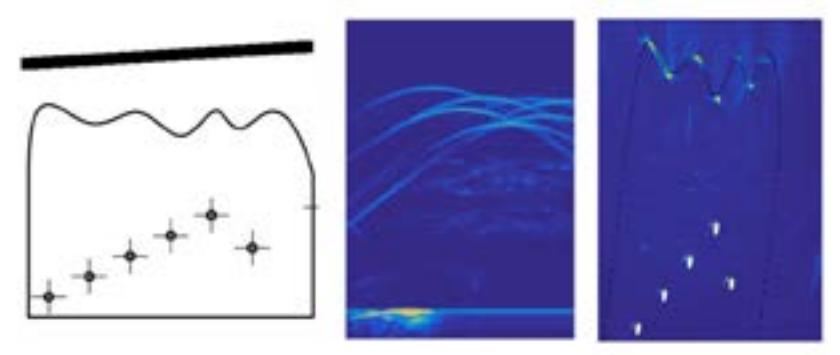
In this work, we develop an effective methodology for inspection curved objects in various conditions such as noisy environment or not ideal transducer and object position knowledge.