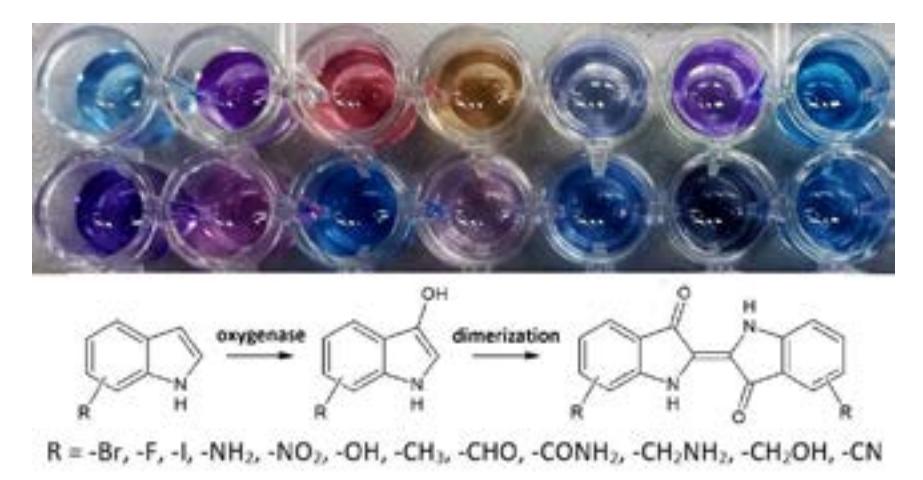
Indigo is one of the oldest pigments used in the dyeing industry. With the rise of modern sciences, we gained the ability to modify the indigo molecule and create new pigments with novel applications, based on special semiconductor properties [1-3]. Compared to silicon semiconductors, indigoid pigments have the advantage of being biodegradable and also very stable when exposed to air and water [4]. In order to overcome the hazardous effects of chemical indigo modifications, enzymatic synthesis was used to obtain novel variants of indigo [5,6]. Nevertheless, the selection of indigoids with desirable chemical modifications is still insufficient.
Here, a set of new indigoid pigments synthesized by employing bacterial enzymes is presented. Screening of metagenomic libraries for indole-oxidizing activities revealed several oxygenase enzymes, capable of oxidizing indole derivatives to corresponding indigo derivatives. In total, seven different oxygenases capable of performing oxidation of 24 different indole derivatives to corresponding indigoid pigments were characterized. Indigoids synthesized by these enzymes were the following: different regioisomers of indigo dimethanol and indigo dicarboxaldehyde, 5,5'-diaminoindigo, 5,5'-di(aminoethyl)indigo, 5,5'-difluoroindigo, 5,5'-dihydroxyindigo, indigo-5,5'-dicarbonitrile, indigo-5,5'-dicarboxamide, 5,5'-dibrom-7,7'-diiodoindigo, 5,5'-dichloro-7,7'-diiodoindigo, 7,7'-dibromoindigo, 7,7'-diiodoindigo, 7,7'-dimethylindigo and 7,7'-dinitroindigo. Most of these pigments demonstrated different colors (Fig. 1) and different visible spectra absorbance patterns. Moreover, some indigoids, including indigo dimethanols and indigo-5,5'-dicarbonitrile, were produced without the formation of indirubin isomeric form.
To our knowledge, production of some of these pigments has not been reported neither by chemical nor enzymatic methods to date. Due to different spectral properties and additional chemical modifications, these indigoid pigments are potential nanomaterials for novel applications.