
Honey is a sweet, viscous food substance produced by bees from floral nectar. Natural bee honey is a unique sweetening agent that can be used by humans without processing. However, honey can easily be adulterated with various cheaper sweeteners, resulting in higher commercial profits [1]. Commonly used adulterants include high fructose corn syrup, maltose syrup, refined beet and cane sugar etc. Stable isotope ratio mass spectrometry (SIRMS) can be used to determine the adulteration of honey with C4 plant (corn or cane) sugar since its $\delta^{13}$C values are around -10% to -20% but bees use floral nectar from C3 plants which $\delta^{13}$C values are about -22% to -33‰. Significant $\delta^{13}$C value difference between honey and its protein provide valuable information of honey authenticity [2,3].
Five adulterated honey samples were made adding different amounts of sugarcane sucrose syrup (3%, 6%, 9%, 12%, 15%) to pure honey. The protein from the honey was extracted using dialysis membrane with MWCO 12 kDa. Determination of $\delta^{13}$C ratios in protein and honey was carried out with Nu Horizon SIRMS at the University of Latvia, using certified organic reference materials USGS-40 and USGS-41 (L-Glutamic acid). The $\delta^{13}$C values are expressed relative to VPDB. Waters Acquity UHPLC system with Waters Acquity UHPLC BEH Amide column (100 mm \times 2.1 mm, $\varnothing$ 1.7 μm) combined with Waters ELSD detector were used to determine weight fraction of sucrose in pure and adulterated honeys
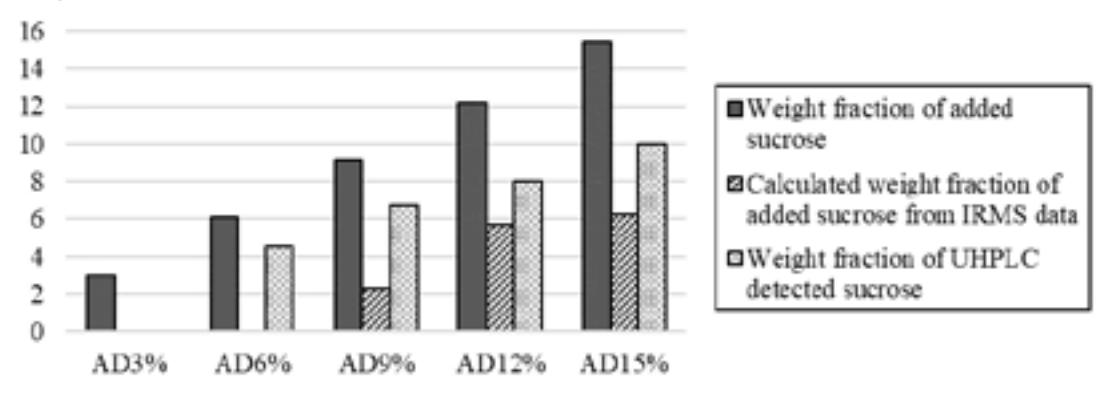
Despite dissimilar results of calculated and detected weight fraction of sucrose to actually added weight fraction, results show expected increase in $\delta^{13}$C values as C4 plant adulterant concentration increases to honey. Only adulterated honeys with added sucrose content higher than 6% weight fraction have high enough $\delta^{13}$C value difference between honey and protein to calculate amount of added sucrose. UHPLC method did not provide exact quantitative information to components which weight fraction is lower than 5%.