In recent years much interest is attracted by various modifications of porphyrins in order to obtain desired chemical photophysical properties. This enables various applications ranging from pigments to photodynamic therapy [1].
Nonetheless, synthesis of porphyrin derivatives is often challenging, low yielding and poorly selective. Therefore, extensive understanding of mechanisms and thermodynamics of these reactions is crucial for planning efficient synthesis.
In this communication we present mechanistic insights on selective azomethine ylide and nitrone additions to meso-tetrakis(pentafluorophenyl)porpholactone, based on density functional theory (DFT). Calculations for minimum energy pathways were performed at IEF-PCM/B3LYP/6-31G(d) level of theory, together with deliberate analysis of frontier molecular orbitals (FMO) carried out at IEF-PCM/B3LYP/6-311G(d,p) level of theory.
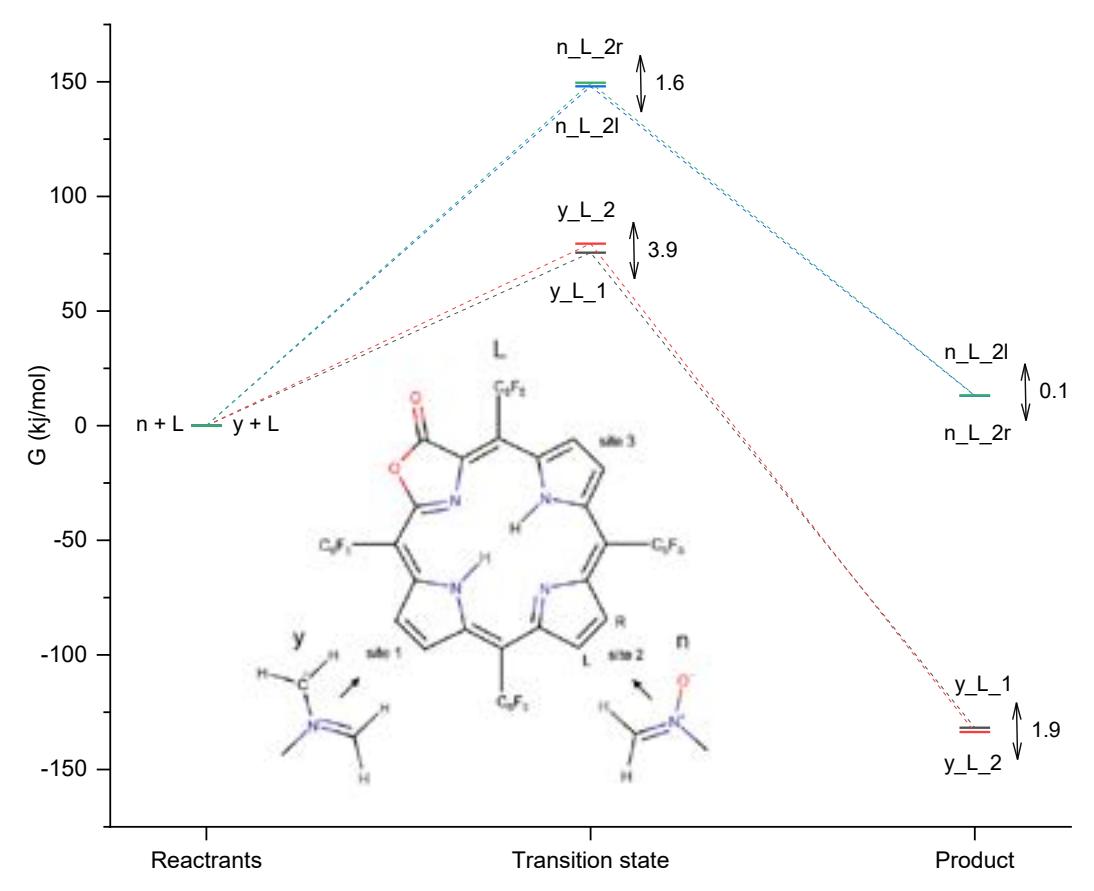
Gibbs free energy calculations (fig. 1) correctly predicts the outcome of both reactions and suggests that additions are controlled differently: kinetic control in case of addition with azomethine ylide and thermodynamic when nitrone is used. To shine some intuition on seemingly controversial stabilities of transition states we applied FMO theory, which has been known to be decent in explaining selectivity 1,3-dipolar cycloadditions for a long time [2,3]. Careful examination of FMO's geometries and their atomic contributions indicates to be reasonable and intuitive tool in foreseeing selectivity for this type of reactions.