Saccharomyces cerevisiae (S. cerevisiae) is a robust eukaryotic organism that has a fast metabolism and can survive in both aerobic and anaerobic conditions. Yeast cells can be used in biosensor and microbial fuel cell development but as all systems involving live cells, they are often less efficient than conventional energy generators i.e. fossil fuels etc., unstable and prone to breakdown overtime. To increase the efficacy of these microbial systems the cells can be immobilized in different matrices, chemically modified i.e. with polypyrrole [1] or operated without aeration and mixing.
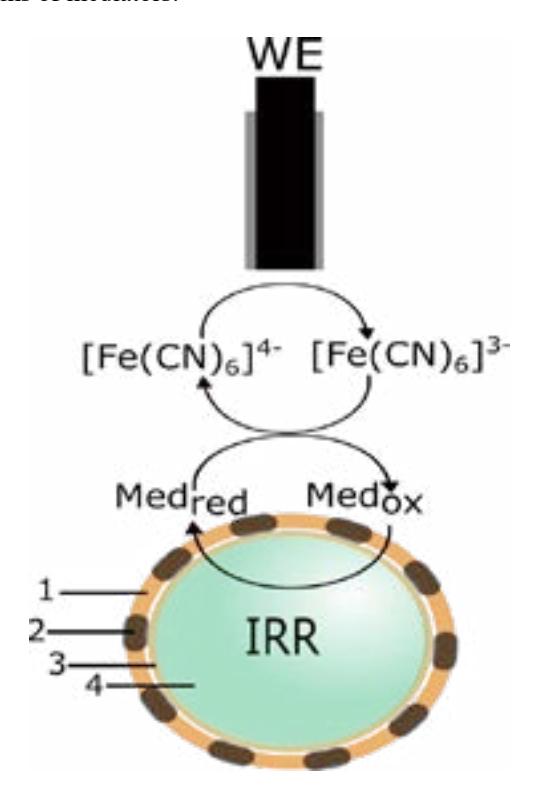
In our study we focused on the electrochemical investigation of S. cerevisiae under varying conditions using different electron transfer mediators. Lipophilic mediators participate in redox reactions with intracellular reduced species in the respiratory pathway while the hydrophilic mediators shuttle the electrons to the electrode in the extracellular medium. Mediators compete with oxygen for the role of electron acceptor and their effectiveness may depend on the presence or absence of oxygen [2], [3].
We performed cyclic voltammetry, chronoamperometry and spectrophotometric measurements on the system of yeast cells, grown in aerobic and anaerobic conditions, modified with polypyrrole, and measured with different pairs of electron transfer mediators. The metabolic activity of S. cerevisiae is evaluated indirectly by electrochemical and optical methods which detect the reduced forms of mediators.
Fig. 1. A representative scheme of the double redox mediator pair action in a polypyrrole modified cell. WE – working electrode; Medox/Medred – the oxidized/reduced form of the mediator; 1 – cell wall; 2 – polypyrrole; 3 – plasma membrane; 4 – cytoplasm; IRR – intracellular redox reactions;
[1] Andriukonis, E. et al. (2018) 'Yeast-assisted synthesis of polypyrrole: Quantification and influence on the mechanical properties of the cell wall', Colloids and Surfaces B: Biointerfaces. Elsevier B.V., 164, pp. 224–231. doi: 10.1016/j.colsurfb.2018.01.034.
[2] Rawson, F. J., Downard, A. J. and Baronian, K. H. (2014) 'Electrochemical detection of intracellular and cell membrane redox systems in Saccharomyces cerevisiae', Scientific Reports, 4, pp. 1–9. doi: 10.1038/srep05216.
[3] Ramanavicius, A. et al. (2017) 'Scanning electrochemical microscopy based evaluation of influence of pH on bioelectrochemical activity of yeast cells – Saccharomyces cerevisiae', Colloids and Surfaces B: Biointerfaces. Elsevier B.V., 149, pp. 1-6. doi: 10.1016/j.colsurfb.2016.09.039.