
Materials of the following composition Na3M2(PO4)2F3, where M = V, Ti, are investigated as prospective cathode materials for sodium-ion batteries. For instance, cathodes based on polycrystalline Na3V2(PO4)2F3 exhibits a reasonably good gravimetric capacity (equal at least 128 mAh/g) with an average voltage ca. 3.75 V [1]. Recent studies revealed that the gravimetric capacity value is rather structural than redox limited [2]. This issue may be overcome by substituting vanadium by another transitions metals, e.g. titanium and synthesis of this materials in nanocrystalline form via thermal nanocrystallisation of glassy analogues [3, 4].
Nanograins obtained during this process are characterised by an average diameter from 5 to 50 nm, which results not exclusively in growth of gravimetric capacity value, but higher electronic conductivity as well. Synthesis of glass from calculated amounts of properly chosen compounds is a two step method, described in detail in [5]. The batch is melted in a furnace at ca. 1300 °C and subsequently is rapidly cooled via melt-quenching technique. Thermal events occurring in the obtained materials were investigated by differential thermal analysis (DTA) method.
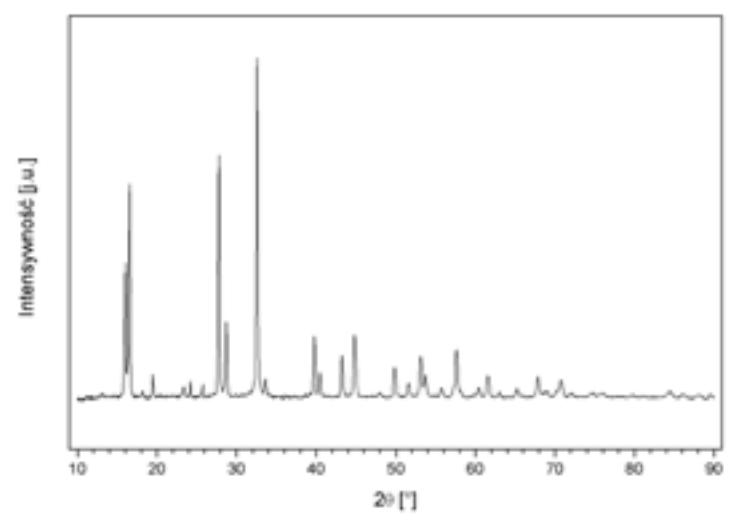
The amorphousness of initial samples along with observation of thermal nanocrystallization process were executed by X-ray diffraction in function of temperature (HT-XRD). Samples crystallized in pure NASICON-like structure (Fig. 1) and what is important, an average dimension of grains was below 100 nm. Measurements of electrical conductivity in function of temperature were performed using impedance spectroscopy method and proved that thermal nanocrystalisation of glassy analogues of Na3M2(PO4)2F3 systems may improve total conductivity of as-received materials.