Experimental and theoretical studies of polyfunctional ampolydentate ligands is one of the most interesting directions in modern coordination chemistry. The study of their properties and structure allows us to obtain metal complexes having valuable optical, magnetic, catalytic, biological, etc. properties.
Due to the attractive photophysical properties of some lanthanide complexes, these compounds are promising for the broad range of possible applications, from luminescent labels up to the materials used in electroluminescent diodes (LEDs).
Among the polydentate ligands, a particular place is occupied by the carbacylamidophosphates (CAPh) - compounds having a functional fragment -C(O)N(H)P(O)-. Presence of phosphoryl group in the composition of CAPh ligands determine to them a high affinity for the majority of metal ions, and especially for rare-earth elements. The ampolydentate character of the CAPh ligands allows to obtain different bi- and polynuclear homo- and heterometal coordination compounds.
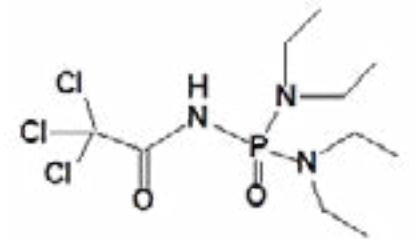
Cationic lanthanide(III) complexes with general formula $[Ln(L)_{2}Dipy_{2}]BPh_{4}$, (where Ln = La, Eu, Tb, Nd, Gd, Lu; $L^{-} = bis(N,N'-diethylamido)(N''-trichloroacetyl)triamidophosphate$ ion (Fig. 1); Dipy = $\alpha,\alpha'$- dipyridyl), were synthesized and characterized by means of elemental, IR, 1H NMR, luminescence and UV-Vis spectroscopy.
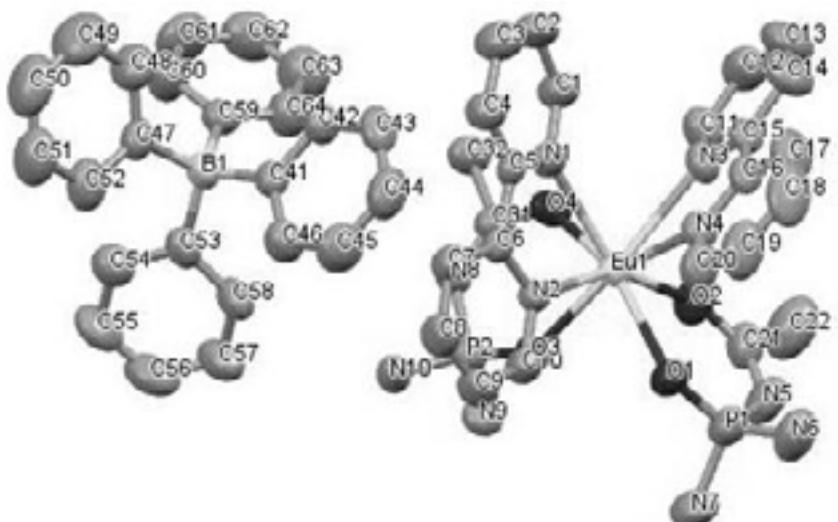
The single crystal structure of Europium complex was determined by X-ray diffraction method. It was found, that the complex has an ionic structure and tetraphenylborate-ion acts as an anion. The deprotonated form of the ligand is coordinated to the europium ion in a bidentate manner via the oxygen atoms of the phosphoryl and the carbonyl groups with formation of six-membered metallocycles. The $\alpha,\alpha'$-dipyridyl molecules are coordinated to the metal in a bidentate manner via the nitrogen atoms completing the coordination number of europium to eight.