
The European Spallation Source (ESS) is a state-of-the-art neutron source being built in Lund, Sweden. This large-scale user facility will be used for studies of the structure and dynamics of the materials using neutrons [1]. The worldwide experience from operation of spallation sources is very limited. An inevitable side effect of the neutron generation is the production of various radionuclides, resulting from spallation in the proton accelerator and target, as well as from neutron activation of surrounding structures, soil, and air. A fraction of the radionuclides formed in ESS may be released to the environment during normal operation, as well as in potential accidents. Quantitative evaluation of these radionuclides is vital ensuring the radiological safety of the workers, general public and environment.
We are using the existing competence at Lund University and developing it further regarding modeling of radionuclide production and measurement for ESS-specific radionuclides. In 2017-2018, natural and man-made radionuclides were assessed in the Lund area, including gamma-emitters as well as the pure beta-emitters 3H and 14C [2].
In current experimental work we are focusing on difficult-to-measure radionuclides (alpha and beta emitters), requiring radiochemical sample pre-treatment before activity measurements. Radiochemistry methods are being developed related to separation of ESS-specific radionuclides prior to measurement. Two basic techniques - liquid scintillation counting (LSC) and alpha spectrometry – are employed for detection of the relevant radionuclides. LSC was successfully used for evaluation of tritium of the background samples of e.g. air, precipitation, ground and surface water, bioindicators, crops, fruits, milk and sewage sludge. Results of current environmental tritium activity in the ESS site measured using LSC technique show natural levels of tritium only – less than than 5 Bq/l. We aim to make the most of the LSC technique, not only for tritium, but also for other radionuclides that are expected to be formed in the ESS facility, e.g. 14C, 22Na, 55Fe, 90Sr. Alpha spectrometry is planned to be used for the detection of actinides, polonium and alpha-emitting rare-earth metals (148, 150Gd, 146Sm, 154Dy).
A review of publications which radionuclides are expected to be formed in the ESS and the independent Monte Carlo modeling of ESS components provides basis for our preparation for further measurements after the start of ESS operation. The review of available publications allowed us to identify 234 most important radionuclides, with half-life longer than 10 hours.
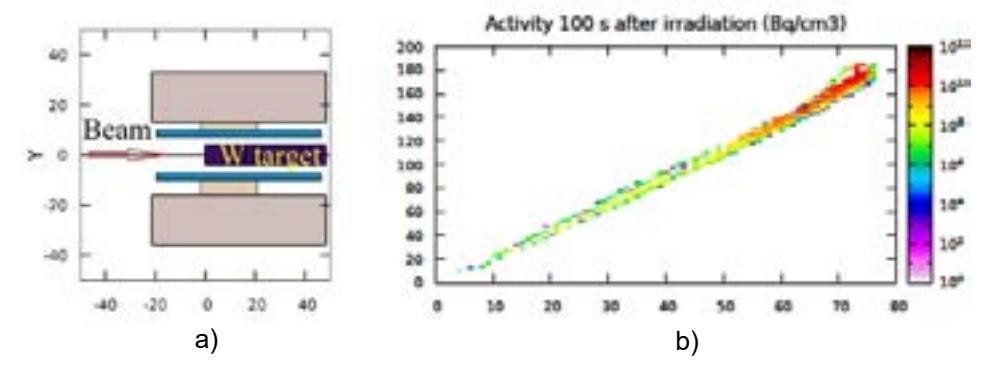
In order to perform independent analysis, a simplified model of ESS target and main surrounding structures was created for target composition modeling using FLUKA code (see Fig. 1a). The preliminary radionuclide production results given by the model are mapped in the Fig. 1b. Our preliminary model evaluation results show that content of tritium (the most mobile radionuclide) generated in the target is in the same orders of magnitude as in other publications [3]. The same correspondence is noticed for 148Gd, the alpha emitter which has the highest effective dose coefficient for inhalation among the radionuclides generated in the target.
Further analysis of the results and model development is planned to be performed in the near future, also using other modeling tools (e. g. MCNP code).