Rare earth metal (lanthanide) upconverting nanoparticles (UCNPs) have been extensively investigated because they possess unique optical properties. Depending on their size, crystal structure and composition, UCNPs are known to exhibit down-conversion luminescence or efficient upconversion luminescence. During upconversion process low-energy near-infrared (NIR) radiation photon is converted into higher energy (visible light) photon by multi-photon process [1]. UCNPs have shown their potential to be used in bioimaging, biosensors, noncontact fluoresce thermometers and drug delivery systems [2-3].
The main focus of this research was to synthesize NaGdF4:Yb3+,Er3+@NaGdF4 and NaGdF4:Yb3+,Er3+@NaYbF4 nanoparticles using thermal decomposition method and determine how UCNPs size and core-shell structure effect photoluminescence (PL) properties.
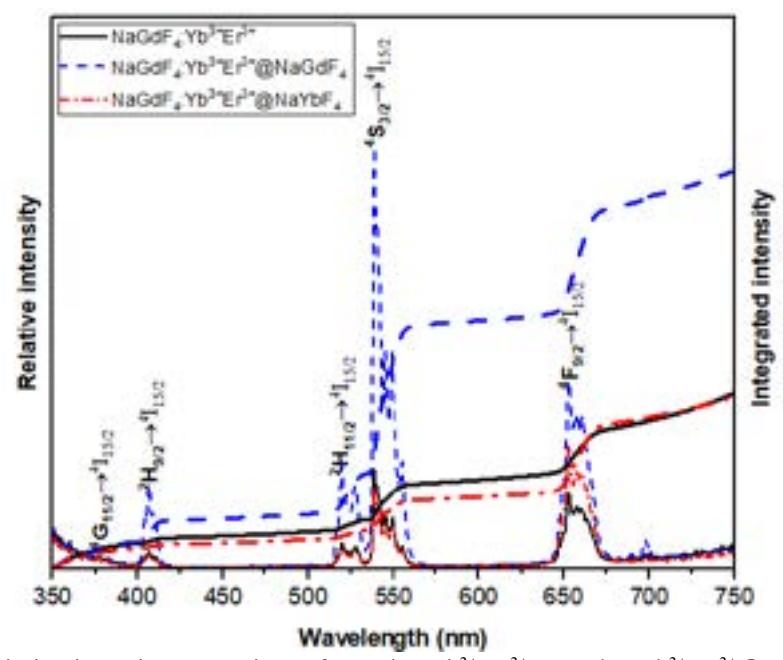
The obtained results show that synthesis temperature and core-shell composition influence UCNPs size, agglomeration and upconversion luminescence. The PL spectra (Fig. 1) of NaGdF4:Yb3+,Er3+@NaGdF4 and NaGdF4:Yb3+,Er3+@NaYbF4 nanoparticles (synthesized at 310 °C, 90 min) proves that inert NaGdF4 shell increase emission intensity while active NaYbF4 shell decrease it when compared to NaGdF4:Yb3+,Er3+ core nanoparticles. Powder X-ray diffraction (XRD), scanning electron microscopy (SEM) and photoluminescence (PL) spectra have been recorded to characterize the size, crystal structure and emission intensity of the synthesized samples.