
Due to the value of extra virgin olive oil (EVOO), adulteration has become an important issue in the food industry. EVOO, being the highest quality olive oil is the most prone to be fraud. Typical adulterants would likely include edible oils that are much cheaper than EVOO, as there will be a greater profit for the producer [1]. Mostly three adulterants of different nature are used - sunflower oil, rapeseed oil, and soybean oil, and can be present in the range 5–95 %.
Near-infrared spectroscopy and principal components analysis were already employed to develop a discriminant analysis equation that could identify correctly the type of seed oil present in extra virgin olive oil in 90 % of cases [2]. Unfortunately, more accurate analysis is needed when EVOO is mixed with other types of olive oils. Fluorescence spectroscopy combined with second-order chemometric methods was previously used for the detection of extra virgin olive oil adulteration with lower quality olive oils [3], however this method cannot give the precise chemical information of the sample. In this work vibrational spectroscopy methods FTIR-ATR and FT-Raman are employed to analyze different qualities of olive oils. Vibrational spectroscopy was chosen since every molecule has its distinct vibrational spectra in the infrared region [4]. Furthermore, chemical information can be taken from the spectra which makes vibrational spectroscopy more precise than fluorescence measurements. By analyzing the registered spectra spectral markers which allow the discrimination of EVOO from lower quality olive oils were identified. Comparison between the FTIR-ATR spectra of EVOO and olive pomace oils are shown in fig. 1.
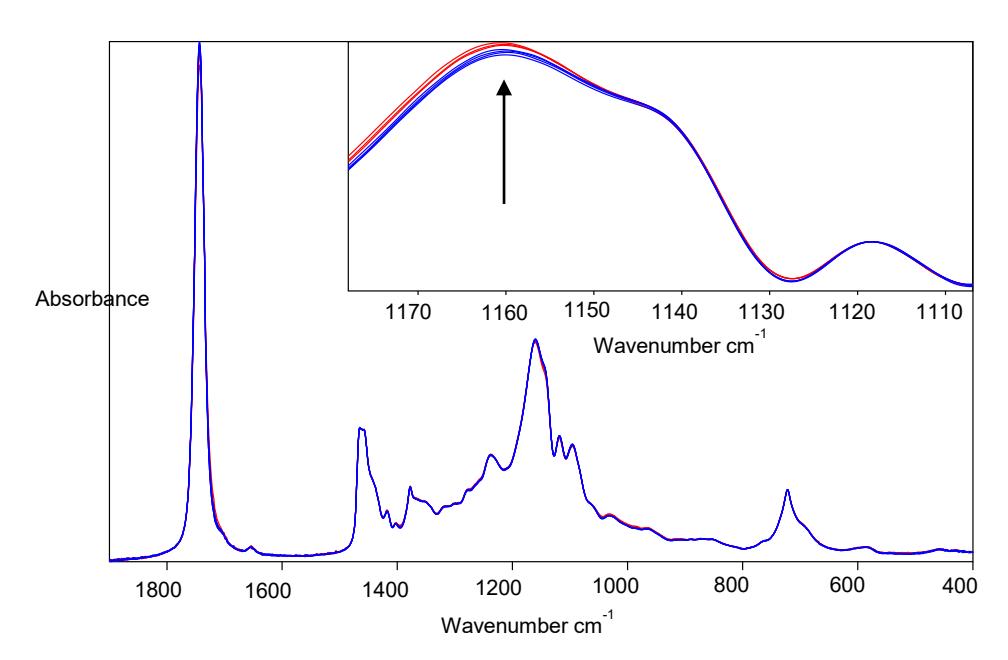
In conclusion, the analysis of the FTIR-ATR and FT-Raman spectra of various qualities of olive oils have shown that vibrational spectroscopy can be used identify EVOO adulterated with olive pomace oil. More research is needed in order to find the spectral markers which would allow to distinguish olive oils of similar quality.