Biological membranes are a base in biology of the living cell. Membranes are the hydrophobic barrier which separates two water soluble compartments and a supra-molecular entity that has vital structural functions. Notably, they are involved in many exchange processes between the outside and inside cellular spaces [1]. The profile of interaction between protein and lipid is highly dependable on the physical properties of lipid bilayer. That is why very important to investigate nanomechanical stability of a membrane. It is interrelated to phase state behaviour and various other influencing aspects such as temperature, cholesterol [2, 3] and membrane proteins. Due to the complexity of cell membranes, biomimetic models are needed to acquire current knowledge of the molecular processes occurring in membrane. To simplify the investigation of phospholipid and cholesterol interactions, the use of artificial membranes is an approach that allows manipulation of the lipid composition by choosing the desired ratio of the lipids [2].
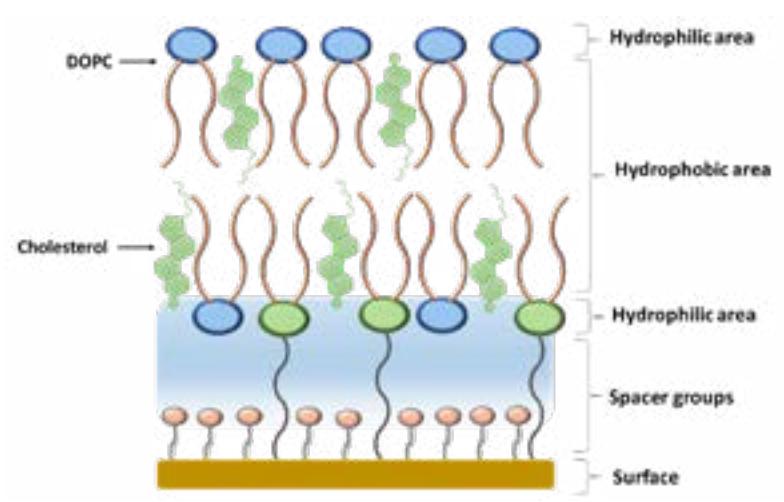
Tethered bilayer lipid membranes (tBLM) – a platform for a rapid artificial bilayer formation. To investigate the effect of cholesterol on DOPC (dioleoylphosphocholine) tBLM, various lipid mixtures of DOPC/cholesterol (1/0, 8/2, 7/3, 6/4, 1/1) were prepared. Simultaneously, Atomic Force Microscopy (AFM) imaging and Force spectroscopy studies were carried out. Fig. 1 shows a schematic image of tBLM structure in the presence of cholesterol molecules.
Force curves (force (nN)-versus distance (nm) curve) show the deflection of cantilever during scanner movement (z-displacement) towards the surface and backwards. The profile of the curve highly depends on the nature of interaction between the AFM tip and analysed surface. Through applying contact models from force curve nanomechanical properties as adhesive force, Young modulus (elasticity) etc. are calculated.
In order to determine the mechanical strength of the DOPC bilayer as a function of cholesterol, experiment was carried out using force curves over 3 μm×3 μm area at the places of interest. The breakthrough force (FB) is an appropriate indicator to gauge the mechanical stability of the membrane. Average roughness values were measured in 3 independent experiments. This let us know about arrangement and distribution of cholesterol in lipid bilayer. Cholesterol pulls the lipid closer and fills the gap between the head group in small concentration. This result higher mechanical stiffness in fluid phase membranes and smaller values of surface roughness. However, at higher additions of cholesterol, surface roughness increases as increases the gap between the head groups [3].