
The most used over-the-counter (OTC) drug in European Union countries is paracetamol, also known as N-acetyl-para-aminophenol (APAP). Wide usage of this drug leads to high rate of accidents due to its missuse. Pharmacokinetics of 4 g of APAP dose after oral ingestion reveals that peak level of it in blood serum reaches 0.4 mM [1] after 40 minutes. Toxicity of APAP is stated when concentration of it in blood exceeds 1 mM when measured 4 hours after acute overdose. Nevertheless, the results of a blood test in clinical trial may take 6 hours or more to obtain, resulting delay in the treatment [2]. Application of colloidal SERS for detection of APAP traces in blood proposed by us is fast, simple and clean method which is capable to reduce the amount of blood needed for diagnosis down to a few drops. The extremely high sensitivity of the surface enhanced Raman scattering (SERS) method takes advantages of both molecular specificity of the Raman scattering and enhanced signal from the nanoparticles (NPs). Such spectroscopic approach allows identification of the molecules in micromole or even lower concentrations.
This work covers SERS based detection of APAP drug in blood samples. Spectral markers and possibility of APAP to be detected by means of SERS spectroscopy was set by examining SERS spectra with different concentration of APAP solutions in water: 1 mM, 100 μM; 75 μM, 50 μM, 25 μM, 10 μM, 1 μM. The spectra of APAP solutions in human blood or blood serum at different concentrations: 10 mM, 5 mM, 2.5 mM, 1 mM, 0.5 mM, 0.25 mM, 0.13 mM were measured to find appropriate preparation procedure of the samples. Possibility of APAP detection in real conditions was checked by measuring SERS spectra of blood serum after consumption of bolus dose of 4 g APAP.
The spectra of 10 mM and 1 mM of APAP solutions mixed with 10 times diluted blood serum are presented in figure 1. APAP molecule consists of benzene ring to which one amide and one hydroxyl group are attached in para conformation. In accordance with SERS spectral features of APAP solution in water, the orientation of APAP molecule changes from facing the nanoparticle with amide group to being oriented parallel to the NP surface. Such structural change is reasoning the changes in intensity of APAP vibrational spectral bands at 1168 cm-1 (phenyl – N bending) and 863 cm-1, 836 cm-1, 805 cm-1 (out of plane skeletal deformation) (Fig 1.). APAP can be identified from 1168 cm-1 and 863 cm-1 spectral bands in both blood and serum samples. Blood sample contains amino acids, fibers and other blood constituents which makes detection of APAP in blood difficult. SERS spectra of serum promises better results of drug detection and is composed mainly of spectral bands of uric acid. Our experiments of APAP detection after consumption of 4 g of APAP reveals that our proposed SERS method is not suitable for detection of traces of APAP in blood at such low concentrations. Sensitivity of the detection can be increased up to 1.3 mM concentration by using serum instead of whole blood.
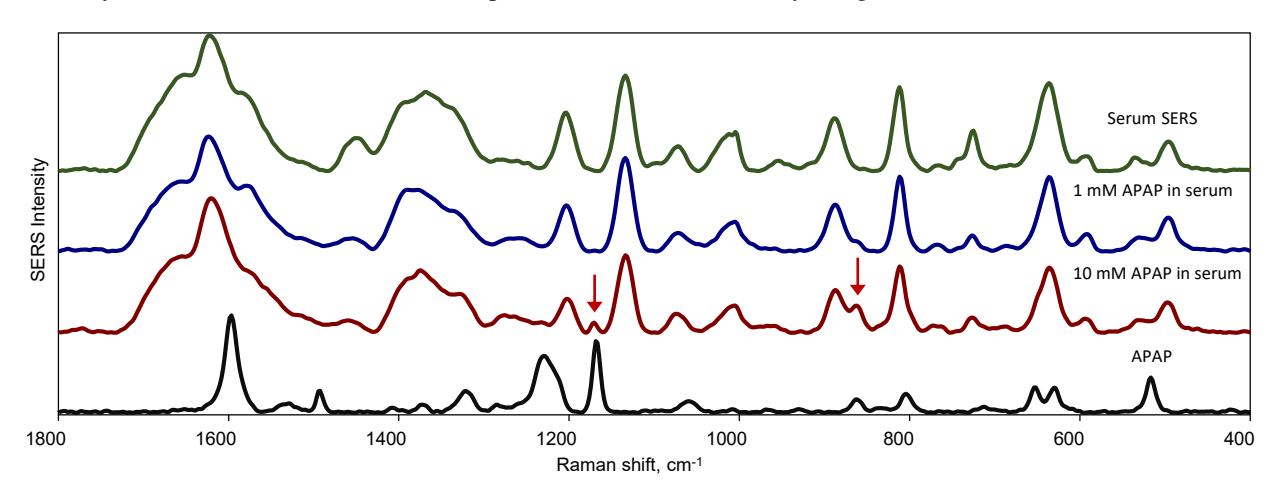
In conclusion, the concentration of APAP molecules in blood serum after consumption of 4 g should be about 0.4 mM [1] which is too low to detect with our current method by means of SERS. The lowest possible concentration of detection of APAP molecules is 1.3 mM in blood serum which indicates toxic and seriously toxic concentration.