
The adamantyl moiety was recognized as an essential fragment in various pharmacologically-active drugs. Adamantane derivatives possess antiviral activity against Influenza A virus and HIV, as well as, anti-microbial, anti-inflammatory and anti-proliferative activities. It is also known that adamantyl group changes the properties of known drugs or provides an important pharmacophore for the design of new drugs [1].
Nowadays, the modern quantum-chemical methods are high-reliable tools to establish the molecular structure of organic compounds. In its turn a high accuracy of the structural predictions is a prerequisite for the adequate simulation of the chemical and physical (i.e. optical) properties.
In this study, the structures (Fig. 1) and spectral properties (IR, Raman, UV/Vis and circular dichroism spectra) of four adamantane-based derivatives, namely ethyl 4-{[3-(adamantan-1-yl)-4-phenyl-5-sulfanylidene-4,5-dihydro-1H-1,2,4-triazol-1-yl]methyl}piperazine-1-carboxylate (compound I), (Z)-3-(adamantan-1-yl)-1-(3-chlorophenyl)-S-benzylisothiourea (compound II), N-(adamantan-1-yl)-4-phenylpiperazine-1-carbothioamide (compound III), 1-(adamantan-1-yl)-3-(3-chlorophenyl)thiourea (compound IV) have been obtained at the DFT (B3LYP/cc-pVTZ) and Multi-Reference Perturbation Theory (SA-CASSCF/XMCQDPT2 [2]) levels of theory calculations.
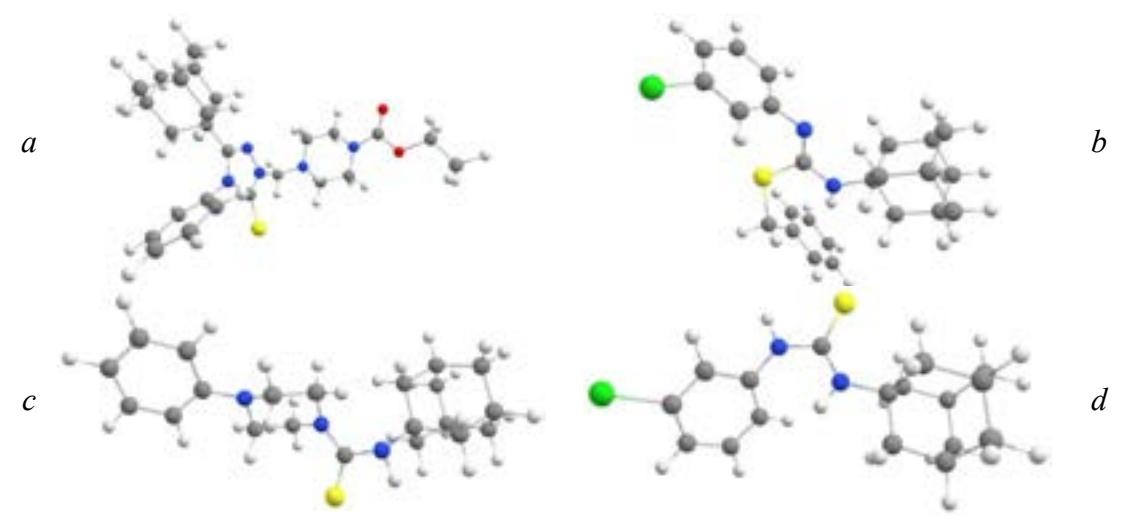
Firstly, conformation analysis has been carried out for the all compounds. We found two (compound I), three (II), two (III) and four (IV) stable conformers.
The FT-IR spectra of the compounds for the crystalline phase have been measured in the range of 3200–650 cm-1 in the reflection mode. The Raman scattering spectra of the compounds also for the crystalline phase have been measured in the range of 3200–150 cm-1 using a compact solid-state Nd:YAG laser (second harmonic, 532 nm wavelength). Then the vibrational IR and Raman spectra were calculated and the experimental spectra were interpreted using the results of our calculations.
The UV/Vis spectra of solution of the compounds in ethanol were measured in the range of 450-200 nm. The UV/Vis spectra simulations at the Time-Dependent DFT and Multi-Reference Perturbation Theory levels of theory demonstrate unsuitability of the TDDFT for description of the experimental spectra of the compounds. It is highly probable that this is a consequence of the intramolecular charge transfer (ICT). In contrast, the MRPT results are in a good agreement with the experimental spectra.
The functional groups of the compounds having donor and acceptor properties and taking part in ITC have been determined on the basis of Mulliken and Löwdin atomic populations analysis.