
Alumina (Al2O3) coatings are often produced by electrochemical oxidation (anodization) to obtain good mechanical properties, improved surface hardness, paintability, corrosion resistance and other desirable characteristics for robotics, aerospace, medicine and other high-tech areas. Porous Al2O3 coatings up to 100 μm in thickness, which can be obtained by anodization, are highly beneficial for industrial purposes (i.e. painting), because anodic coating easily adsorbs dyes due to capillary action [1]. In this study, a non-destructive analysis method, based on Raman spectroscopy, was developed to monitor penetration rates of organic dyes into fully anodized Al foil.
Al foil of 99.95% purity (0.03% Fe, 0.02% Si) with a sheet thickness of 50 μm was anodized in H2SO4 / oxalic acid electrolyte at 15 °C and 200 A/m² anodic current density according to previous procedure [2]. The process was stopped when anodizing current dropped to 0A in order to retain ~20 nm barrier layer, which assured foil integrity. Two types of commercially available chromium-complexed anionic azo dyes Sanodal Deep Black MLWTM and Sanodure Green LWNTM (Clariant, Switzerland) referred to as the "black dye" and "green dye" respectively, were chosen for the detection of penetration rates throughout fully anodized Al foil. A droplet of 5 μL with a dye concentration of 2 g/L in water was deposited onto the anodized foil for Raman spectroscopy analysis.
Echelle type spectrometer RamanFlex 400 (PerkinElmer, Inc.) used a diode laser of 785 nm beam as an excitation source. A fiber optic cable with working distance of 7 mm and a thermoelectrically cooled CCD detector were used for spectra collection at room temperature. The beam was focused into a ~200 μm diameter spot on surface of Al foil with laser power of 30 mW. Before dye deposition the beam was advanced into the inside of anodized Al pores from the bottom until the intensity of background photoluminescence (PL) achieved the maximum value. Periodically, Raman spectra were collected within 30 min after the dye deposition. Each spectrum accumulated 3 scans with an integration time of 10 seconds, which were divided by the total accumulation time followed by subtraction of background. The polystyrene standard (ASTM E1840) spectrum was used for calibration. Spectral analysis was obtained with Grams/AI 8 software (Galactic Industries Co, USA).
PL phenomena that have negative effect for Raman scattering was negligible for fully anodized Al foil. Therefore, Raman spectroscopy was used to determine the penetration rate of commercially available anionic azo dyes throughout fully anodized Al foil. Most intensive vibrational modes of 1285 cm-1 for black dye and 1264 cm-1 for green dye were assigned to endocyclic CN and exocyclic CN functional groups respectively, Fig. 1.
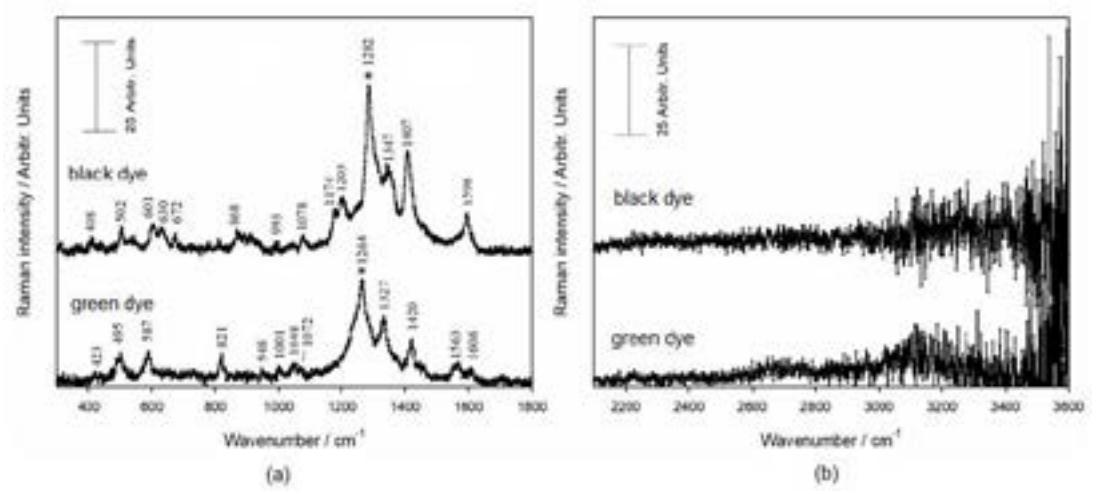
It was observed that after 30 minutes the most intensive vibrational modes of each dye showed a small but distinct shift to lower frequencies. According to higher frequency shift of C-N vibrational mode (1285 cm-1 to 1282 cm-1 vs 1265 cm-1 to 1263.6 cm-1) the interaction of the black dye with the anodized Al foil was much stronger than that of the green dye.
Raman spectroscopy successfully monitored the penetration rate and the behavior of azo dyes in the anodized coating. This method could be applied to characterize newly developed organic dyes for Al coloring.