
Due to increased importance of information technology in communication field a huge attention has been focused on electromagnetic radiation (EMR) absorbers. Among well researched conjugated polymers, polypyrrole (PPy) is a cheap and tunable organic semiconductor which can be incorporated into fabrics to create flexible electronics or EMR shielding materials [1]. The aim of this work is to enhance conductivity of PPy by adding anionic dopants to create promising electrically conductive composite films for smart textile industry [2].
Two types of experiments were carried out: when dopant is in matrix and catalyst polymer solution or when dopant is in pyrrole (Py) monomer solution. 4 different dopants were used: sodium dodecyl sulfate (SDS), sodium polystyrene sulfonate (PSSNa), sodium dodecylbenzene sulfonate (DBSNa) and dioctyl sodium sulfosuccinate (DOSS). Composites were synthesized with only one dopant and on a dielectric woven wool substrate coated with polymerization reaction catalyst FeCl3 evenly distributed throughout PVA (polyvinyl alcohol) adhesive polymeric matrix using screen printing with particular 3 x 3 cm square pattern. Coated specimens were dried at 60 °C then spray-coated with monomer Py and water solution and after quick polymerization reaction dried again at 60 °C.
Experimental investigations of manufactured samples have been performed using an analytical model of electromagnetic wave shielding effectiveness calculations in 8-40 GHz frequency range. Composites were characterized using scanning electronic microscopy and Fourier-transform infrared spectroscopy.
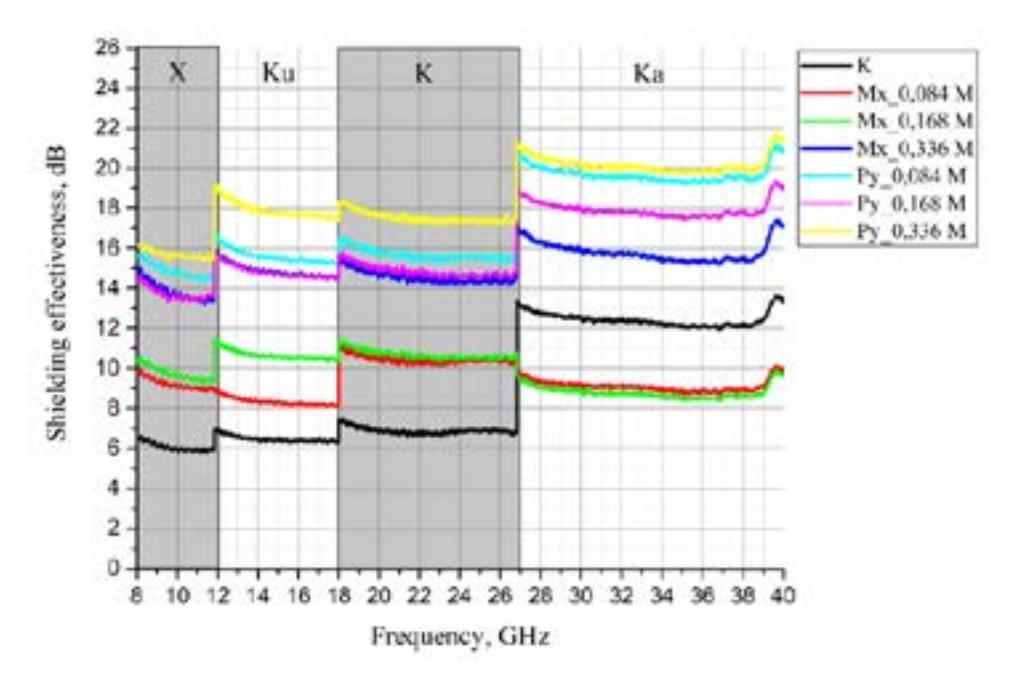
In conclusion, the most promising composite was achieved using SDS dopant with 0,336 M concentration, when dopant was in Py monomer solution. Comparing this composite with sample with no dopants, shielding effectiveness was improved approximately by ~9 dB. These results give a bedrock for doped polymer composites use in smart textile industry which can be used to develop commercially available flexible electronics.