
It is well known that excessive automotive engine exhaust emissions of gases (carbon monoxide, hydrocarbons, nitrogen oxide) and particulate matter (PM) pose a threat to public health and urban air quality. Human exposure to polluted air containing PM can cause numerous health problems, such as cardiovascular, cerebrovascular and respiratory diseases [1]. In an effort to reduce automotive emissions modern cars use a variety of engine modifications, catalytic systems and filters which in turn alter the isotopic ratio of carbonaceous particles (isotopic fractionation effect). Diesel engines are of particular interest due to higher production of particulates (soot) in comparison to gasoline engines [2].
The aim of this work was to examine particulate matter fractionation in automotive emissions using $\delta^{13}$C and 14C measurements. Experiments were performed in a specialized dynamometer laboratory to ensure reproducibility and accuracy of the results. Four light passenger vehicles with different fuels (diesel, 95 RON gasoline, 98 RON gasoline) were tested using simulated transient cycles in urban and rural areas. Additionally, driving modes of 30, 60, 90 km/h and at maximum power were tested. Engine exhaust particulate matter was collected on quartz filters. Later, isotopic ratio $\delta^{13}$C values of fuel and exhaust carbonaceous particulates were measured using stable isotope ratio mass spectrometer. $\delta^{13}$C values were then compared and level of isotopic fractionation determined, as shown in Fig 1. Finally, biofuel fraction was evaluated using accelerator mass spectrometer which required additional intermediate sample graphitization step.
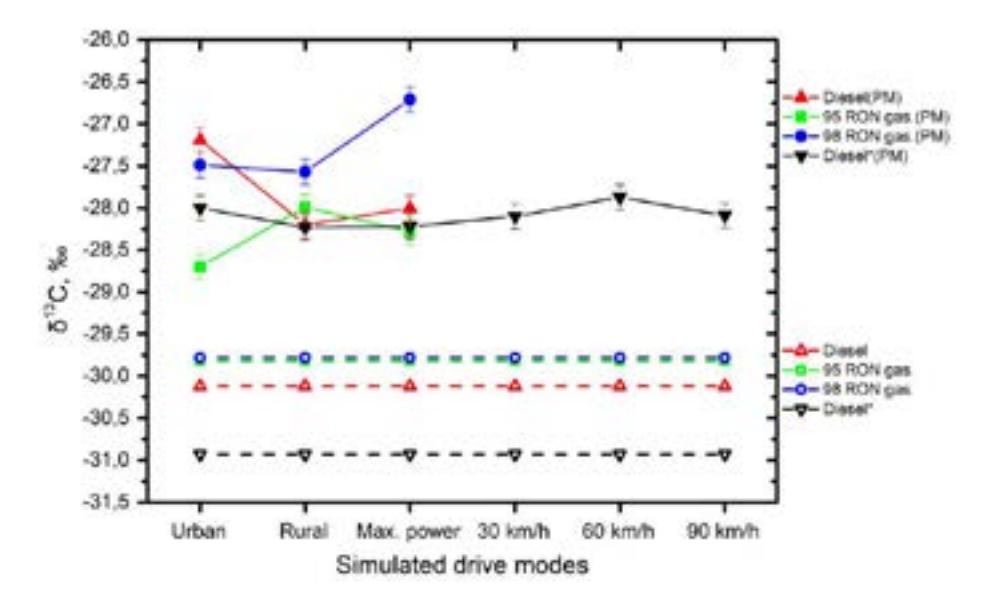
The obtained results show particulate matter $\delta^{13}$C values ranging from -28.7 % to -26.7 % during separate driving modes. Most significant fractionation was observed when using diesel fuel. Average $\delta^{13}$C value was found to be equal to -27.9 % in automotive emissions and fractionation $\Delta^{13}$C (particulates-fuel) equal to 2.1 %. Finally, it was determined that biofuel fraction in fuels differed considerably and ranged from 6.1 % to 13.5 %.