
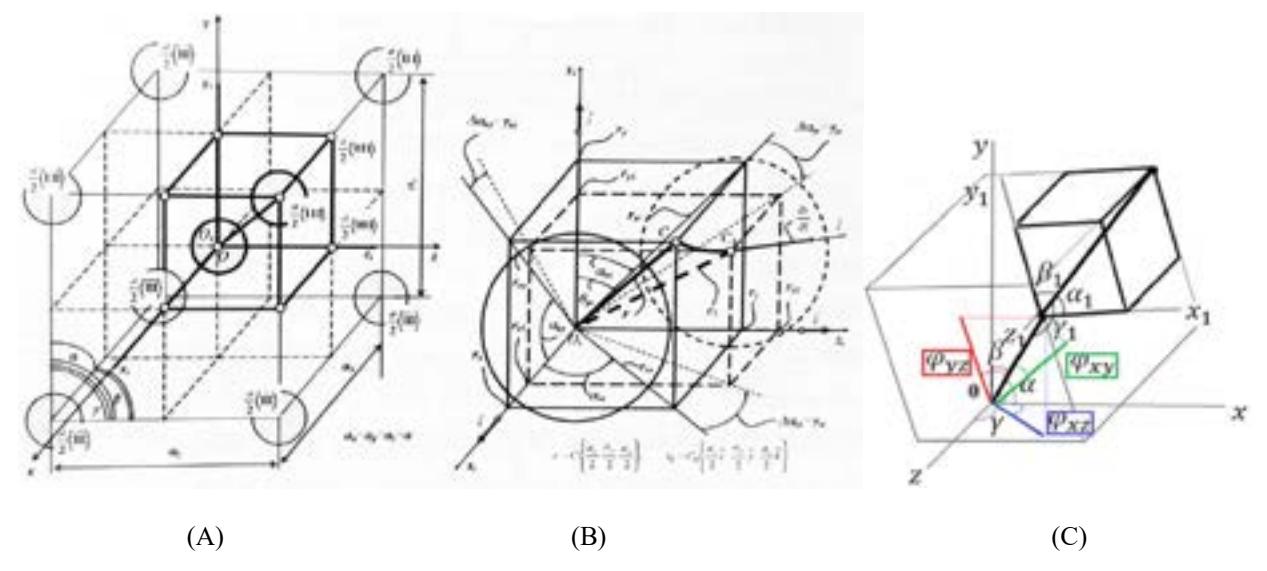
As the standpoint of this study is a creation of method based on the multi-scale modelling that was chosen as a way to collect and, in the case of high probability comparable with the experimental results or methods, to share all possible natural phenomena as some evidence of physical reality in crystalline materials. This method describes the complex behavior of atomic systems aligned by different spatial angles in neighbor microstructures. Virtually this allows us analyzing wave properties in discrete lattice/microstructure as the result of complex multi-directional neighbor impact. Firstly, the modeling of BBC-lattice deformation is presented according to the theory on computation of elastic constant like Poisson's ratio from the atomic perspective in close connection with experiment data obtained at macro-scale (Fig. 1). Poisson's ratio is expressed as:
$$v_i = -\frac{\varepsilon_{yi}}{\varepsilon_{xi}};\tag{1}$$where $\varepsilon_{xi}(d_{xi},\alpha_{xi},C)$ and $\varepsilon_{yi}(d_{yi},\alpha_{yi})$ – longitudinal and transverse deformation, C – coefficient of deformation intensity $\frac{1}{\xi} \le C \le \frac{1}{\xi^2}$ while $\xi$ – parameter which show one atom inertia to another according to the movement direction and depends on deformation level $(0 < \xi \le 1)$ .
Parallel to development in statistical mechanics, atomistic modeling is shown as a maturing and perspective tool in solid state physics and materials science and for the fine investigations of bulk characteristics and their elastic limits in crystalline materials.