
Recently it was found [1] that in a mirrored array of split ring resonators (SRR) (Fig. 1) Fano resonance arises due to direct interaction of the 3rd order plasmonic mode and the lattice mode. Investigated metasurface consisting of SRRs was formed on a thin polytetrafluoroethylene (PTFE) layer (125 μm, $ε=2.2$). It was shown that the resonance appears when the specific resonance mode is excited, which is weakly coupled with external electromagnetic field. This specific mode is known as a dark mode contrary to a usual light mode, which has large radiation losses.
In the present paper we numerically investigate the influence of the surface conductivity of 2D coating that covers the metasurface on Fano resonance amplitude. As an example of such a surface might be the graphene layer that is now widely investigated. The surface resistivity of it can be changed by increasing a number of layers in a coating, or by changing the Fermi energy of the graphene by applying external DC electric field [2].
The custom-made program based on a finite-difference time-domain method was used. For the simulation of the SRR array, the unit cell shown in Fig. 1 is modelled with periodic boundary conditions at the lateral edges. The differentiated Gaussian pulse is generated using total-field-scattered-field plane wave source. The incident wave falls perpendicularly to the SRR array surface. The modelling domain is truncated by the uniaxial perfectly matched layers to introduce the absorption of waves without reflection. To calculate the transmittance spectra, a method based on the generalized Goertzel algorithm is used [3].
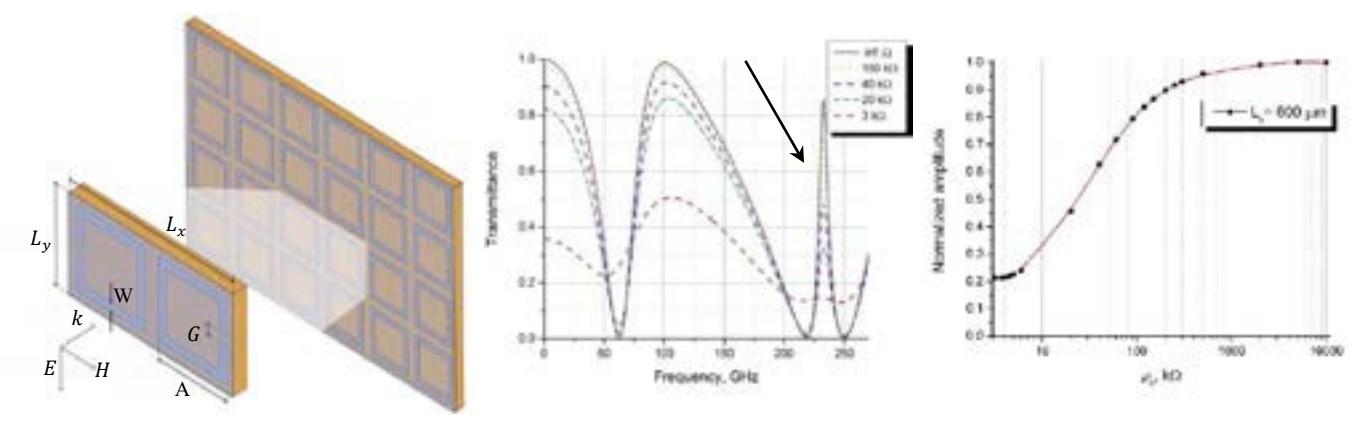
Calculation results of transmittance spectra versus frequency for different values of the surface resistivity of the 2D layer are shown in Fig. 2. Values of the surface resistivity is indicated in the figure. It is seen that by decreasing the surface resistivity Fano resonance amplitude (marked in the figure by arrow) strongly decreases, whereas its influence on plasmonic resonances is less pronounced. When the surface resistivity exceeds 10 MΩ per square Fano resonance amplitude reaches uttermost value, which was calculated [1] without the conductive layer. In the opposite case, when the surface resistivity approaches to 3 kΩ per square Fano resonance totally disappears and conductive layer by itself manly governs the transmittance through the investigated structure. Dependence of the Fano resonance amplitude normalized to its maximum amplitude at $\rho_s = \infty$ is shown in Fig. 3. It is seen that in the intermediate range of the surface resistivity the maximum influence of it to the Fano resonance amplitude is observed which might be used for sensing applications.