Bismuth telluride is one of the best thermoelectric materials performing at room temperature. Layered crystal structure of bismuth telluride provides possibility of Bi layers insertion and results in formation of (Bi2)m(Bi2Te3)n superlattices with low lattice thermal conductivity.
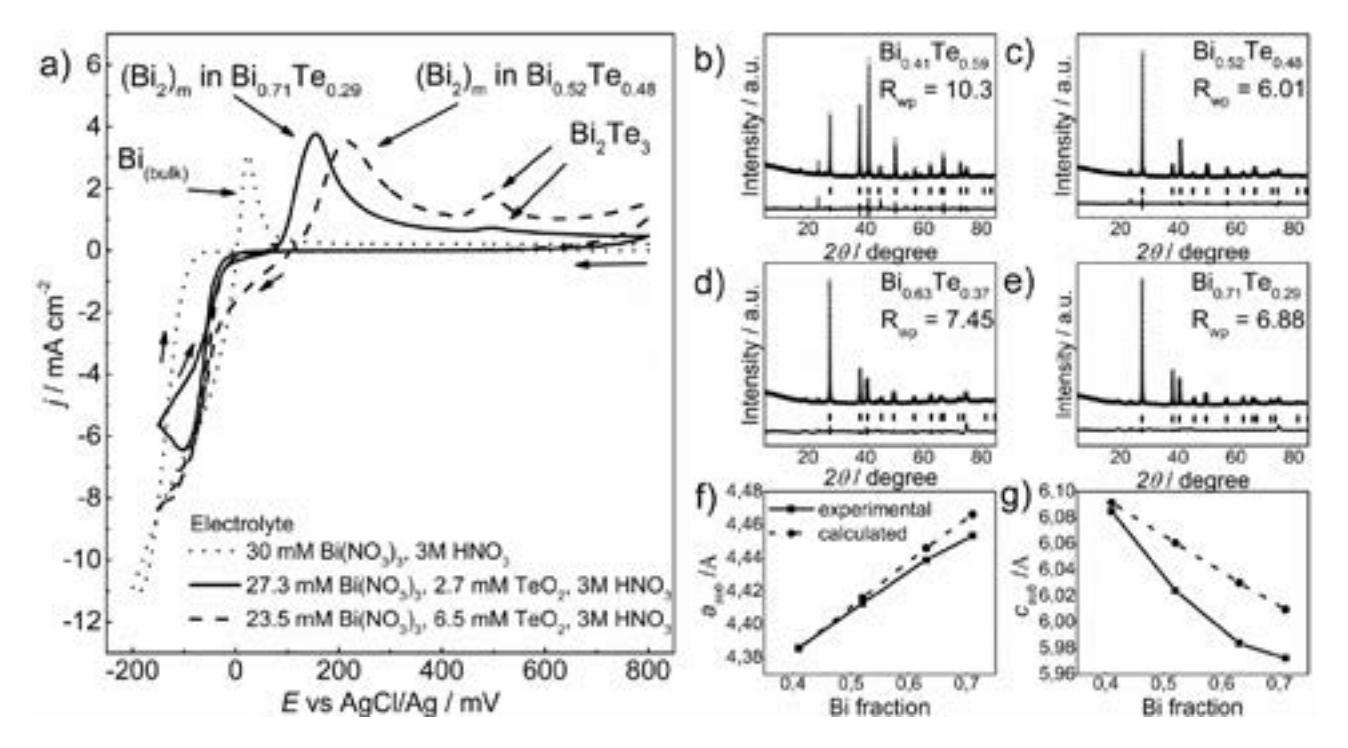
Solid state synthesis of (Bi2)m(Bi2Te3)n was reported in [1,2]. Here we present our results on the electrodeposition of the similar superlattices. Cyclic voltammetry profile of (Bi2)m(Bi2Te3)n electrodeposited onto stainless steel in acidic Bi3+ and TeO2 containing aqueous solution shows two anodic peaks; the first one was attributed to selective (Bi2)m oxidation (Figure 1) and the other one to oxidation of the remaining Bi2Te3. We have found that electrochemical pulse deposition onto stainless steel from acidic Bi3+ and TeO2 solutions of different Bi3+/TeO2 ratio below (Bi2)m anodic oxidation potential can give layered compounds. The bismuth mole fraction in the deposits varies from 0.41 to 0.7; this is in agreement with the phase diagram for Bi/Te binary system that shows the possibility of binary compounds formation in the range from Bi2Te3 to Bi7Te3. The layered structure of the deposits was proved using XRD analysis, XPS analysis, and TEM. Rietveld refinement of XRD profiles has shown that all the deposits corresponded to the subcell of the same symmetry as Bi2Te3 (R-3m) and lattice parameters $a \approx 4.0$ Å, and $c \approx 6.0$ Å. Refined a and c show clear dependences on bismuth mole fraction (Figure 2) in the films similar to those reported for superlattices obtained by solid state synthesis [1]. Moreover, based on our data, bismuth bilayers can be selectively removed by applying the electrode potential in the range between the (Bi2)m anodic oxidation peak and the anodic peak attributed to Bi2Te3 oxidation. The anodic removal of bismuth bilayers was accompanied by lattice parameters change to those characteristic of bismuth telluride. We observed this electrochemically stimulated structural change only on samples with initially high bismuth content.