
In the phosphorescent devices, to reduce quenching associated with relatively long excited-state lifetimes of triplet emitters and triplet-triplet annihilation, triplet emitters are normally used as emitting guests in a host material, and thus suitable hosts are widely investigated for the phosphorescent devices [1, 2]. For electrophosphorescence from triplet guests, it is important that the triplet level of the host would be larger than that of the triplet emitter to prevent reverse energy transfer from the guest back to the host [3]. Another essential requirement is the ability of the material to form stable amorphous films. This property guarantees that the guest stays uniformly diluted in the host to minimize the effect of concentration quenching [4].
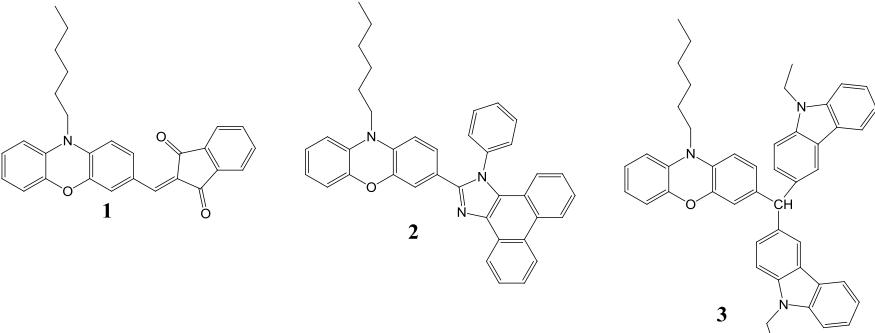
The structures of phenoxazine-based host materials 1-3 is shown in Fig. 1. 10-Hexylphenoxazine was firstly synthesized by reaction of 10H-phenoxazine with an excess 1-bromohexane under basic conditions in acetone. 3-Formyl-10-hexylphenoxazine was then prepared from the 10-hexylphenoxazine by the Vilsmeier formylation procedure. The objective material 10-hexyl-3-(1,3-dioxoindan-2-ylmethylene)phenoxazine (1) was prepared by the reaction of 3-formyl-10-hexylphenoxazine with an excess of indan-1,3-dione in 1,4-dioxane. 2-(10-Hexylphenoxazin-3-yl)-1-phenylphenanthro[9,10-d]imidazole (2) was synthesized by rection of 3-formyl-10-hexylphenoxazine with phenanthrene-9,10-dione, ammonium acetate and aniline in acetic acid. 3-[Bis(9-ethylcarbazol-3-yl)methyl)-10-hexylphenoxazine (3) was prepared in rection of 3-formyl-10-hexylphenoxazine with an excess 9-ethylcarbazole.
Materials 2 and 3 formed homogeneous solid amorphous films with glass transition temperatures of 75 -93 °C. Layers of the synthesized compounds showed ionization potentials of 5.24-5.56 eV. Compounds 2 and 3 were tested as host materials for green phosphorescent OLEDs by using green triplet emitter of bis[2-(2-pyridinyl-N)phenyl-C](acetylacetonato)iridium(III) as the guests. The device with the host of material 3 exhibited the best overall performance. The efficient green OLED using the host demonstrated low turn-on voltage of 3.1 V, a maximum brightness of 5366 cd/m², and maximum current efficiency of 18.3 cd/A. For the technically important brightness of 1000 cd/m² an efficiency above 15.7 cd/A was detected in the device.