Both titanium and its alloys are utilized as a dental implant material and yield high success rate in restoring lost teeth function. Nevertheless, inflammation of the soft tissues due to allergic reaction to Ti and V ions and possible meager soft tissue formation in the immediate proximity of the implant that leads to bacteria induced dental plaque still remain as the predominant problems of titanium implants [1]. Alteration of the surface of the implants is required to make the surface more biocompatible for the tissues whilst restricting possible bacterial activity. Lithium disilicate ceramics are already used as a material for single crowns and partial fixed dental prostheses because of its esthetic and functional properties [2]. Inclusion of calcium and magnesium into lithium disilicate system has a potential to further enhance its antibacterial properties as lithium calcium silicate ceramics have shown potential to improve growth of tissue material [3].
The objective of this work is to obtain crack-free modified lithium disilicate ceramic coatings via sol-gel method while not obtaining any impurities caused by added calcium and magnesium ions as well as displaying higher biocompatibility and low bacterial activity than pure lithium disilicate.
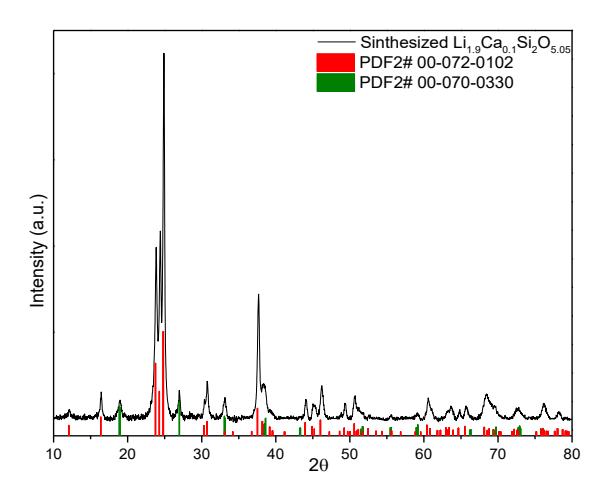
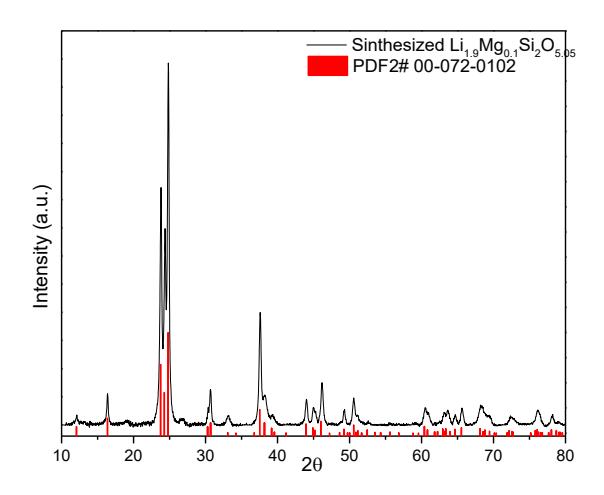
Pure lithium disilicate Li2Si2O5 was obtained by mixing lithium methoxide with tetramethyl orthosilicate in dehydrated methanol, then adding water and complexing agent acetylacetone. For modification with calcium and magnesium same synthesis was used, only difference being the dissolvement of Ca(NO3)2 · 4H2O and Mg(NO3)2 · 6 H2O in dehydrated methanol beforehand. Sols with varying quantities of Ca and Mg were produced, dried into powder, heat treated in 600°C and characterized by x-ray diffraction (XRD). Li2Si2O5 modified with Ca increasing quantity of modifications led to increased development of lithium metasilicate (figure 1), while Li2Si2O5 altered with Mg displayed no impurities whilst modified with similar amount of material (figure 2). Nevertheless, both Li2Si2O5 systems have shown promising results and coatings from modified Li2Si2O5 sols are going to be produced to examine their uniformity and biocompatibility.