
Nitrogen-vacancy (NV) centers in diamonds have proven to be useful for the imaging of magnetic fields created by various magnetic structures [1-3]. When a thin layer of NV centers is located close to the surface of a diamond, magnetic field distributions at the position of the NV layer can be imaged. We have constructed a magnetic field microscope and are using it to study field distributions created by magnetic structures in (and on) thin films made from different materials.
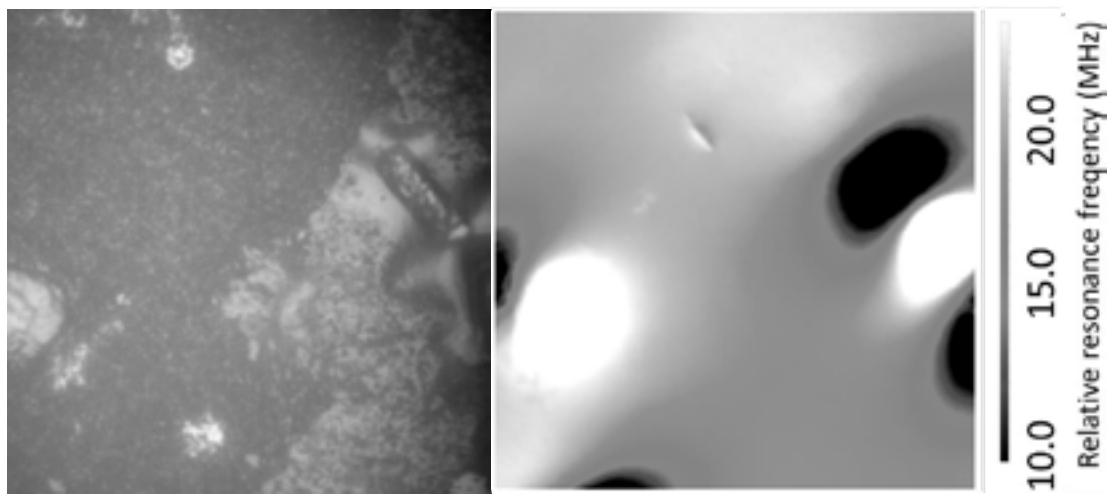
As an example of the measurements in Fig. 1. an optical image in combination with magnetic image can be seen. In the pictures one can see a surface of a thin film made from (Cr0.5Mn0.5)2GaC with some defects on the surface. The strongly magnetic defects are Mn5Ga8 or Cr5Ga8, but the nonmagnetic defects are pure Gallium.
In perspective similar measurements will be done for imaging of magnetic phase transitions of thin films near liquid nitrogen temperatures. As the diamond is chemically, mechanically and temperature resistant the NV centers in diamond crystal has a great potential for characterization of magnetic thin film properties at different production phases.