
Degradable starch micro spheres (DSM) is polymerised maltodextrin with additional crosslinks that form a porous starch network. In addition to an active substance it becomes an innovative delivery system. Loaded DSM applied to amylase containing area gradually break down the three dimensional network of starch releasing encapsulated substance with the end product of glucose making DSM safe and pure drug delivery system. In 2016 Vitaly Kocherbitov and his team explored thermodynamic features of DSM during the gradual hydration using DSC, Sorption calorimetry, SEM, Optical microscopy, gravimetric swelling studies, rheology, and SAXS [1]. They established water quantity limits when DSM undergoes phase transitions (glass transition at 18 wt% of H2O at room temperature), swelling capacity etc. However, the hydration mechanism at molecular level is still not fully understood. In this study, Raman spectroscopy was used as an ideal probe method for that purpose.
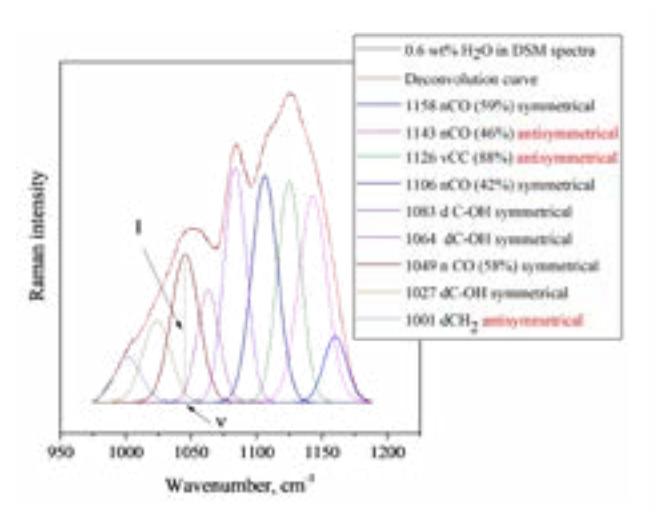
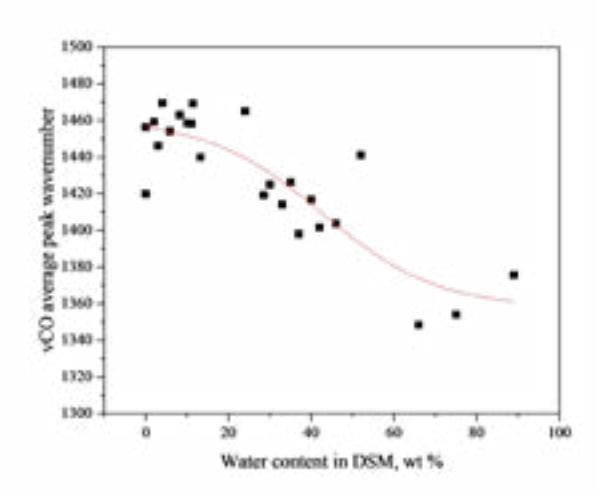
Symmetry of each vibration band was gained from the depolarisation ratio analysis [2]. C-O, C-C, C-H2, C-OH region occurring at 975-1195 cm-1 of mixed stretching and bending vibrations [3-5] and mixed symmetry was chosen for the detailed study (Fig.1). Analysis of stretching C-O mode wavenumber average dependency on water content in DSM-water system showed the shift to lower wavenumber values starting from the glass transition (Fig 2). This shift shows the C-O stretching vibration bond strength decrement due to the formation of hydrogen bonding. Another changes were observed in bending C-OH vibration range during the hydration; namely, the shift to higher wavenumbers and an increase of Gaussian/Lorentzian peak area value. These changes were due to DSM expansion from 18 wt% (glass transition) and the level of freedom increase inside the molecule. Finally, the shift to lower wavenumbers of stretching asymmetric C-C vibrational band and decrease of Gaussian/Lorentzian peak intensity showed the decrease of C-C bonding strength due to the tension inside the molecule during the hydration.
In conclusion, it was demonstrated that the glass transition (18wt% of H2O) is an onset point for molecule expansion and monolayer of water formation outside the molecule.