Nuclear magnetic resonance spectroscopy is a powerful way of probing chemical composition and structure of matter. Typically implementations are based on inductive acquisition which scales poorly with small sample volumes (~nL). Quantum sensors based on nitrogen-vacancy (NV) centres in diamond are a promising alternative owing to their non-inductive detection method.
Most implementations up to now have relied on the stochastic polarization naturally emerging at small sensing volumes (~ 1 pL) to achieve reasonable sensitivity, however this puts a lower bound on the achievable spectral resolution due to spin diffusion of about ~ 100 Hz [2]. Glenn et. al. [3] addressed the resolution issue by substantially increasing the effective sensing volume and detecting the thermal equilibrium magnetization. This resulted in an order of magnitude improvement in resolution (~9±1 Hz) and a molar sensitivity of ~ 370 M (defined as the minimum proton spin concentration necessary to obtain a signal-to-noise ratio of 3:1 in 1 second of averaging time).
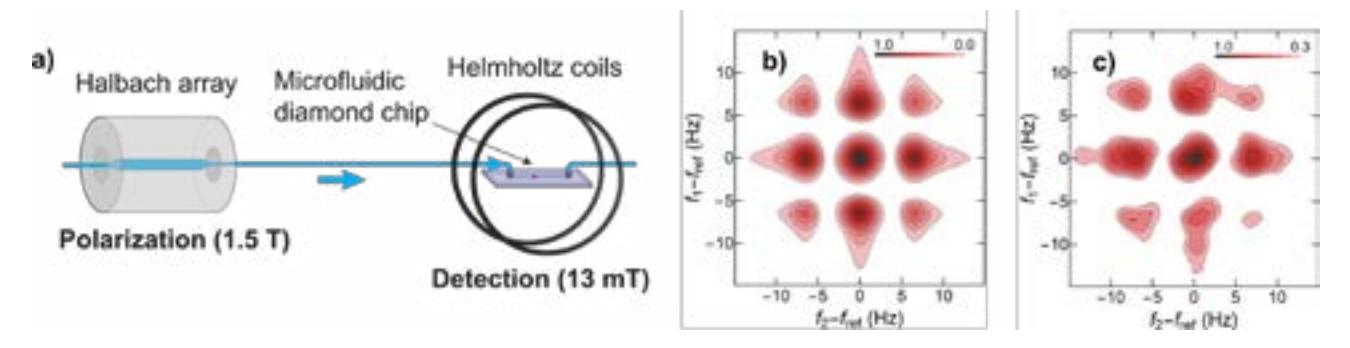
We report [1] a further order of magnitude improvement in resolution and sensitivity, realizing a spectral resolution of 0.65 ±0.05 Hz and a molar sensitivity of ~ 27 M, by spatially separating the pre-polarization and detection phases of the measurement. This is achieved by embedding a 35 × 1000 × 1000 μm thick diamond membrane into a microfluidic chip (see Figure 1(a)) and employing precise spatial and temporal magnetic field compensation. We use the developed
Fig. 1. a) A schematic of the measurement process. The analyte spins are polarized in the Halbach array and then quickly shuttled to the detection region. b) Simulated 2D NMR spectra of 1,4-difluorobenzene developed using the simulation package SPINACH [4]. c) Measured NV NMR spectra of 1,4-difluorobenzene.
platform to measure the first (to the best of our knowledge) experimental 2D NMR spectra obtained using NVs (see Figure 1 (b,c)).
The results represent a significant step towards applications such as mass-limited spectroscopy and single-cell biology. A remaining challenge is the limited sensitivity of our technique which could be further improved using external polarizing agents [5] or polarization transfer from NVs themselves.
[1] Smits, J., Damron, J., Kehayias, P., McDowell, A.F., Mosavian, N., Fescenko, I., Ristoff, N., Laraoui, A., Jarmola, A. and Acosta, V.M., 2019. Two-dimensional nuclear magnetic resonance spectroscopy with a microfluidic diamond quantum sensor. arXiv:1901.02952 (2019).
[2] Aslam, Nabeel, Matthias Pfender, Philipp Neumann, Rolf Reuter, Andrea Zappe, Felipe Fvaro de Oliveira, Andrej Denisenko et al. "Nanoscale nuclear magnetic resonance with chemical resolution." Science357(6346), 67-71, (2017).
[3] Glenn, David R., Dominik B. Bucher, Junghyun Lee, Mikhail D. Lukin, Hongkun Park, and Ronald L. Walsworth. "High-resolution magnetic resonance spectroscopy using a solid-state spin sensor." Nature555(7696), 351, (2018).
[4] Hogben, H. J., M. Krzystyniak, G. T. P. Charnock, P. J. Hore, and Ilya Kuprov. "Spinach - a software library for simulation of spin dynamics in large spin systems." Journal of Magnetic Resonance208(2), 179-194, (2011).
[5] Bucher, Dominik B., David R. Glenn, Hongkun Park, Mikhail D. Lukin, and Ronald L. Walsworth. "Hyperpolarization-enhanced NMR spectroscopy with femtomole sensitivity using quantum defects in diamond." arXiv:1810.02408 (2018).