Over the past years, the unprecedented progress in technology has shaken many industries including lighting industry. Energy-inefficient conventional lamps has been rapidly replaced by the energy efficient and prolonged lifetime LEDs. However, spectra of most of today's commercial white LEDs substantially deviate from natural light. In particular, they have a strong blue component, which is unhealthy for human vision and can even lead to serious irreversible health damages [1]. These shortcomings leave a room for considerable improvements and development of new phosphor materials with photoluminescence resembling natural light.
The most common materials used as phosphors are based on matrices doped with different rare-earth elements (REE) and, especially, lanthanides ions which have remarkable optical properties. They are characterized by [Xe] core, partially filled 4f shell and outer shells that screen 4f shell from the external field. Such an electronic structure leads, in most cases, to optical spectra of those elements consisting of sharp lines characteristic for transitions within the 4f shell, which basically are forbidden [2]. One should, however, be aware that the actual emission spectrum of a given REE center can also depend on a matrix composition.
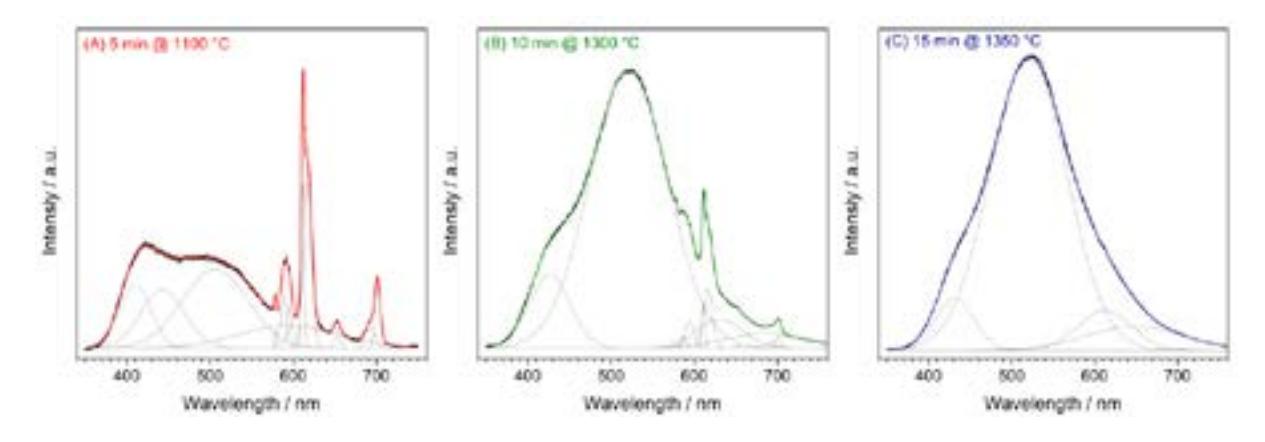
Recently, the research carried out by our group [3] has proven that it is possible to synthesize REE-doped glassy materials whose photoluminescence is much more continuous, smoother and better resembling white light in visual impression. What is more, it has been shown that the synthesis conditions have a strong effect on photoluminescence spectrum. Additionally, one can control the relative Eu3+ and Eu2+ ions concentration and therefore manipulate photoluminescence spectrum.
In this research, Na3Al2(PO4)2F3 glassy matrix doped with 1 wt% of Eu2O3 was successfully synthesized by a melt-quenching process and additional use of a double crucible method [4] in order to provide reducing atmosphere during melting. Three obtained samples with different synthesis parameters (see Fig. 1) were carefully investigated using X-ray diffractometry (XRD), differential thermal analysis (DTA), photoluminescence spectroscopy (PL), X-ray photoemission spectroscopy (XPS), absorption spectroscopy and time-resolved photoluminescence.