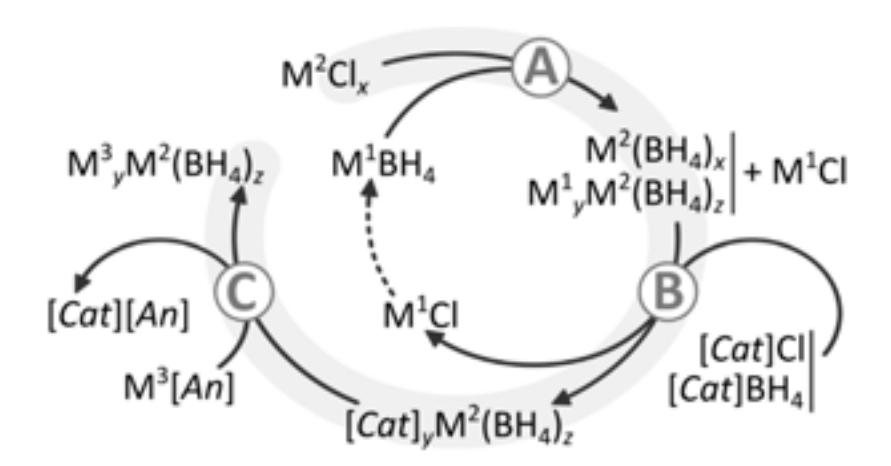
Weakly Coordinating Anions (shortly: WCA) are large anions with the negative charge dissipated over several electronegative atoms and often shielded by bulky organic groups. Due to such construction, they have relatively weak interaction with the cations and are extremely resistant chemically, electrochemically and thermally, which can be utilized in extremely oxidizing environments. Another property of metal salts containing these anions is the solubility of many of them in moderately polar and very weakly solvating solvents, e.g. dichloromethane. This allows the use of these substances as precursors in synthesis of various solvent-free metal ionic compounds, which is often impossible to carry out with other methods. Borohydrides (Fig. 1) or the derivatives of metal amidoboranes are among the compounds prepared utilizing WCAs[1,2].
The main goal of the current work is to close the synthetic process and to re-synthesize Li[An] salt from the usual by-product, [Cat][An], where $[Cat] = [Bu_{4}N]$ and $[An] = [Al(O(CF_{3})_{3})_{4}]$. We aim at development of preferably one-step, high yield method. During the study we use moisture-free environment (Schlenk line and glovebox), wide range of solvents as well as ultrasounds and vibrational mill as the mixing factors. The products are characterized by a range of methods such as powder and single crystal X-ray diffraction, FTIR and NMR spectroscopy, and thermogravimetric analysis.