The ever growing demand for carbon-neutral energy source has led photovoltaic (PV) technologies to become fastest-grow ing form of renewable energy. Among many different PV technologies, organic photovoltaic (OPV), being based on earth-abundant materials and showing short energy payback times, has been exclusively attractive. Donor:acceptor bulk-heterojunction structure has enabled efficient photon – electron conversion mechanism and is by far most widespread structure for OPV. For almost two decades highest power conversion efficiencies (PCE) were obtain with fullerene type acceptors. Fullerene owning to its ball-like fully conjugated structure, which enables high electron accepting and isotropic electron transport capabilities was believed to be crucial part of efficient OPV technology. Other acceptor molecules, generally named nonfullerene (NF) molecules, usually shows low PCE's, mostly due to difficult morphological control. However, NF acceptor resurgence was witnessed in the last three years, with power conversion efficiency sky rocketing to record braking >13.5% values, exceeding those reached by fullerene based systems.
Today there are >100 different acceptor molecules displaying high efficiencies. Most of them are so called A-D-A type molecules, distinct by its two symmetrical electron accepting complexes connected via conjugated electron donating backbone, which itself is surrounded by non-conjugated tails. Most striking feature of such molecules is efficient exciton splitting at low, or even negligible, driving forces made by HOMO/LUMO level mismatch at D/A interface. It enables energy loss minimization and results in high $V_{\rm OC}$ values. Nevertheless, fundamental question on how exciton split into charge carrier in these NF OSC at low driving forces remains open.
To address this problem we have performed conventional transient absorption measurements with 4 different donor:acceptor material combinations (PBDB-T:Y1; PBDB-T-2Cl:ITIC; PDCBT-2F:ITIC; PBDB-T: PCBM) each with few different D/A mass ratios. Ten samples in total were investigated with PCE ranging from 3.2% to 11.1%. Excitation wavelength was chosen to excite either donor or acceptor specifically, thus electron transfer both from donor to acceptor and from acceptor to donor could be observed.
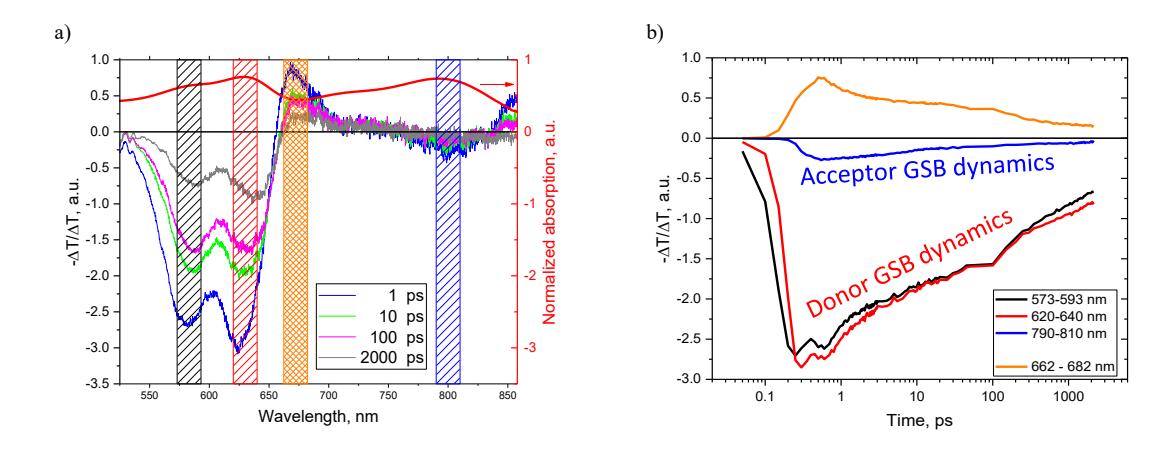
As expected, after exciting acceptor extremely fast (<10ps) hole transfer from acceptors HOMO to donor HOMO orbital was observed, for all the samples with A-D-A type acceptor, which is one of already known distinct feature of NF molecules. However, less expected result manifested after donor's excitation took place. In this case, ground state bleaching of an acceptor was extremely low, especially in case of best performing PBDB-T:Y1 sample. This could mean that either excited state of the donor does not produce a free charge carrier pair (which could not be compatible with high PCE of these samples), or that acceptor's absorption spectra does not change after receiving electron. We hypothesize that electron received in delocalized HOMO orbital might swiftly localize at the electron accepting part of A-D-A complexes, whereas absorption spectra could be mostly determined by the middle part. This would explain no absorption bleaching after receiving electron, and more important, this two-level system, with the localized electron decreasing HOMO level, might also explain high electron transfer efficiency at a negligible HOMO level mismatch.