
Arrays of quantum dots (QDs) can be used in a vast variety of nanoelectronic devices such as quantum computer [1] and others [2]. The use of quantum dots requires understanding of their electronic structure and effect of external fields on it. Confinement potential of a QD can be created both with inhomogeneity of semiconductor material or with the electric field of nanosized gate [3-4] (electrically defined quantum dot – EDQD). In this paper, we study theoretically both types of QDs. Since these systems do not allow analytical solution, this paper also covers the applicability of a three-dimensional anisotropic harmonic oscillator model for describing the magnetic field effect on the electronic structure of cylindrical quantum dot with piecewise constant potential and electrically defined QD, which confinement potential is created by the electric field of the gate in the form of a thin metallic disk [5].
We consider electronic states in three types of QDs: the first type is QD with anisotropic parabolic confinement potential, the second type is EDQD, and the third type is cylindrical QD with piecewise constant potential. These dots are located near the surface of a semiconductor with permittivity $\varepsilon_s$ and electron effective mass $m^*$ in the area z > 0. In XOY plane there is a dielectric layer which creates an infinitely high potential barrier. Uniform magnetic field B is directed along the OZ axis. Within the framework of effective mass approximation, this system is described by the stationary Schrödinger equation for the envelope function $\Psi$ and energy E:
$${\left(-\nabla^2 - i\mu \frac{\partial}{\partial \varphi} + \frac{\mu^2 \rho^2}{4} + \hat{V}\right) \Psi = E\Psi, \qquad z > 0,}\tag{1}$$$${\Psi|_{z=0} = 0; \quad \Psi \to 0 \text{ as } \rho \to \infty, z \to \infty,}\tag{2}$$where $(\rho, z, \varphi)$ are cylindrical coordinates. Effective Bohr radius $a^* = 4\pi\epsilon_0 \epsilon_s J_s^2 / m^* e^2$ for length and effective Rydberg $Ry^* = m^* e^4 / 2J_s^2 \epsilon_s^2$ for energies are used as nondimensionalization parameters. In Eq. (1), $\mu$ is dimensionless value of the magnetic field, defined by the expression $\mu = (a^*)^2 / \lambda_B^2$ , where $\lambda_B = (J_s / Be)^{1/2}$ . The operator $\hat{V}$ is the localization potential.
For quantum dots with anisotropic parabolic confinement potential an analytical solution has been obtained. Solutions for EDQD and QD with piecewise constant potential have been obtained numerically. Energy spectrum and wave functions of the ground and excited states have been calculated for different values of magnetic field and geometrical parameters of the system. The qualitative effect of the magnetic field value on the electron energy spectrum for three types of ODs is also described.
It has been found that a series of anticrossing points for electronic levels takes place at relatively small magnetic fields (e.g. points A and B at Fig. 1). It has been also shown that the model of the near-surface parabolic QD makes it possible to predict the number and position of anticrossing points and quasi-degeneracy of states.
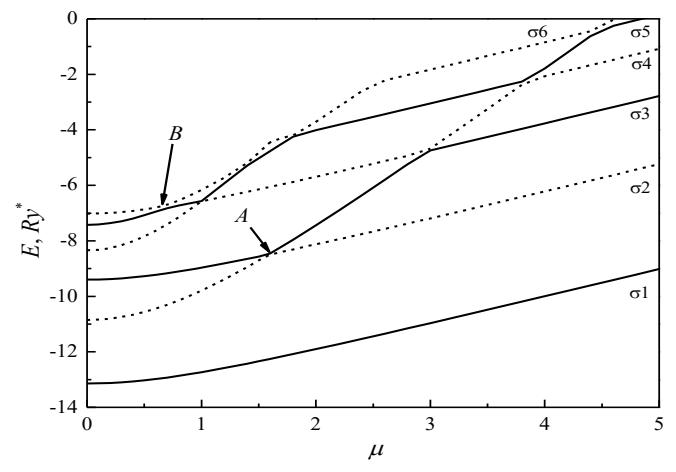
We have also found that the structure of wave functions changes at anticrossing points. Classification of the states of cylindrically symmetric QD based on the model of an anisotropic near-surface parabolic QD is proposed.
The results of this work can be used in development new nanoelectronic devices.