
The purpose of this research was to synthesize new and efficient red light emitting phosphors which possess narrow emission spectrum assuming these luminofors could be used in the production of white LEDs. Therefore, phosphors containing Eu3+ ions are ideal candidates in fulfilling this task due to the fact that their emission spectra consists of few narrow emission lines at approximately 610 nm (see Fig. 1. (b) and (d)). Thus, we decided to investigate the little studied K2(Cs/Rb)Y(VO4)2:Eu3+ phosphors assuming that by changing their chemical composition the emission of Eu3+ ions will be easily manipulated.
Samples of K2RbY(VO4)2:Eu3+ and K2CsY(VO4)2:Eu3+ with trigonal (P-3m1, #164) structure were synthesized via conventional high temperature solid-state reaction. The stoichiometric amounts of precursors (Y2O3, Eu2O3, K2CO3, NH4VO3, Rb2CO3, Cs2CO3) were blended in the agate mortar employing acetone as the grinding media. The obtained powders were transferred to the porcelain crucibles and annealed at 800 °C for 10 h in air [1].
The investigation of structural, morphological and optical properties of the synthesized phosphors was carried out by powder X-ray diffraction (XRD), scanning electron microscope (SEM) analysis, Fourier-transform infrared (FTIR) spectroscopy and UV-Visible spectroscopy.
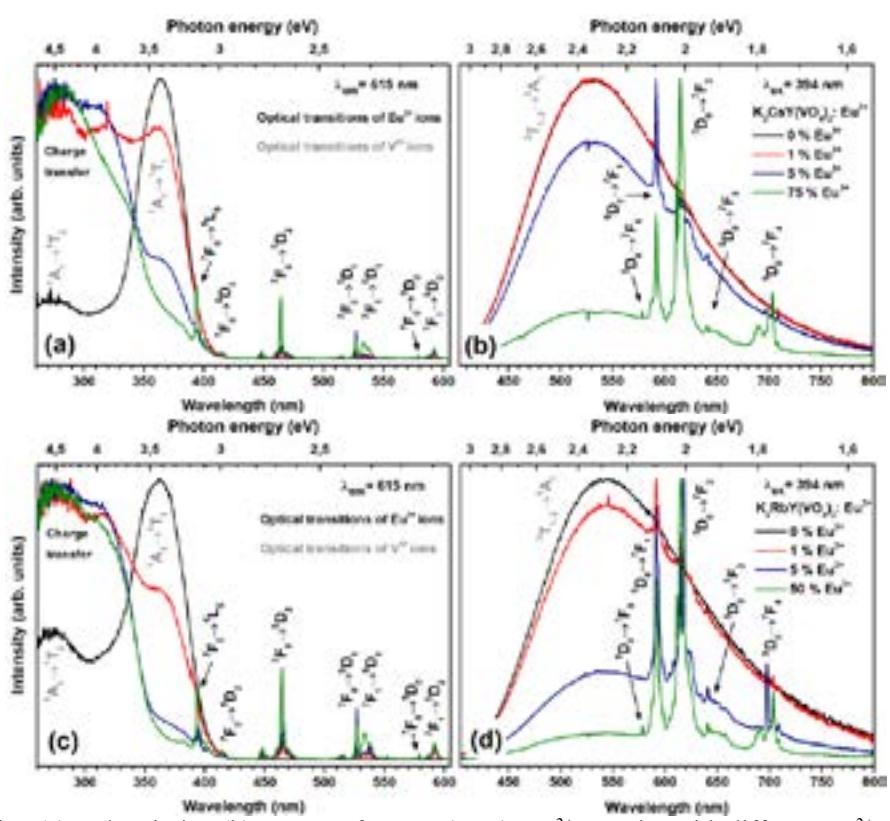
XRD patterns, SEM images and FTIR spectra confirming crystal structure, showing the distribution of crystallites and revealing impurities of samples will be discussed in this work. Moreover, reflection spectra, excitation spectra (${\lambda}_{em}$ = 615 nm), emission spectra (${\lambda}_{ex}$ = 330, 394, 464.5 nm), temperature dependent emission spectra in 77 – 100 K temperature interval, decay curves, photoluminescence lifetime values, external quantum efficiencies, colour coordinates of K2RbY(VO4)2:Eu3+ and K2CsY(VO4)2:Eu3+ phosphors will be discussed.