
Lead-halide perovskites are attractive materials for wet-cast photonic applications, but their toxicity raises serious environmental and health concerns. Therefore, the lead-free perovskites are extensively studied as a possible nontoxic substitution of similar or even superior performance.
Here, we investigate the ultrafast processes of carrier thermalisation, recombination, and diffusion in a set of MASnI3 layers, grown from solution by using different precursors [1]. We employ a unique light-induced transient grating technique (LITG) together with the photoluminescence (PL) and differential transmission (pump-probe) measurements.
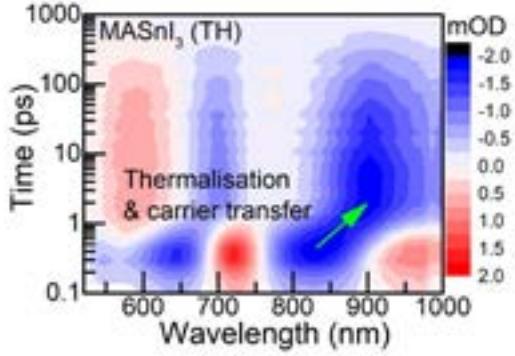
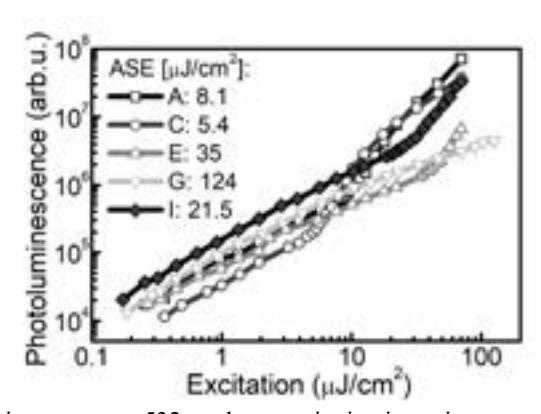
We demonstrate that highly excited Sn perovskite layers exhibit very promising electrical properties: the measured carrier diffusion coefficient and lifetime reach 0.5 – 1.6 cm2/s and 100 – 140 ps, respectively, resulting in the diffusion lengths of 100-150 nm. These values are comparable to those of vapour-deposited lead-halide perovskites [2]. We observe the fast (within 2 – 4 ps) carrier thermalisation in the layers (Fig. 1). We show that amplified stimulated emission (ASE) can be readily obtained in Sn perovskites, yet the ASE threshold strongly depends on layer quality; in our case it varied in the 5 - 120 µJ/cm2 range (Fig. 2). It's notable that the lowest ASE threshold value of 5.4 µJ/cm2 is considerably lower than that reported in MAPbI3 samples with additives [3]. These results suggest that Sn perovskites can be an effective active material for photonic devices like lasers and high power LEDs.