Lanthanide ions exhibit unique luminescent and magnetic properties. The presence of Yb and Er ion pair causes process of radiation upconversion. Such ion pair have the ability to convert near infrared long-wavelength excitation, via two or more photon process, into shorter visible wavelength light [1]. Various salts of gadolinium have outstanding paramagnetic properties, which provides opportunity for application in magnetic resonance imagining. Lanthanide doped NaGdF4 and NaYF4 can be used for different applications varying from magnetic resonance and biological imagining to targeted drug delivery. NaGdF4: Yb3+, Er3+ exhibits upconversion fluorescence peaks in blue, green and red spectral areas under 980 nm IR laser excitation [2] while Gd3+ ions provides necessary paramagnetic properties [2].
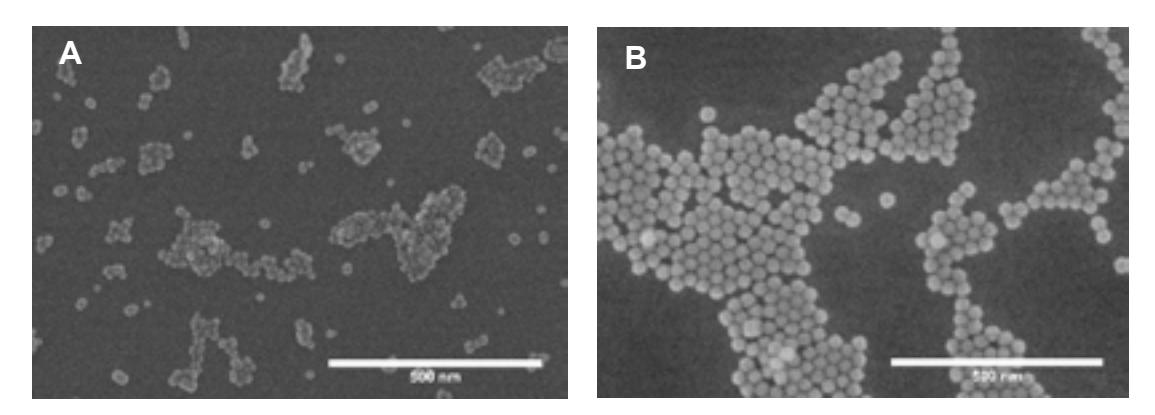
The main purpose of this work was to synthesize single phase monodisperse core NaGdF4 and NaYF4 (figure 1.) nanoparticles using thermal decomposition method. Subsequent step was core-shell particle preparation with the aim to find out optimum synthesis conditions for monodispersed core-shell nanoparticles. We investigated the main thermal decomposition synthesis parameters: temperature, time and ratio of solvents (oleic acid and octadecene).
Scanning electron microscopy (SEM), powder X-ray diffraction (XRD), and photoluminescence (PL) technique have been used to characterize the size, crystal structure and emission intensity of the samples.