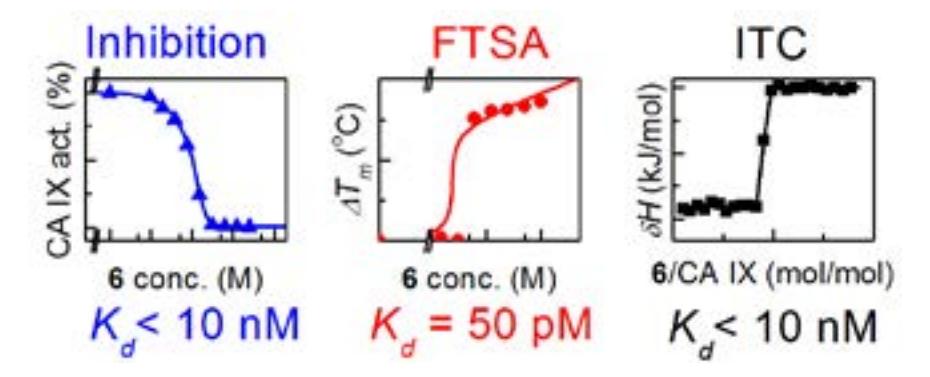
Human carbonic anhydrases (CAs) are targets for drug design due to their role in numerous diseases such as glaucoma, epilepsy, and cancer. Clinically used CA inhibitors-drugs are relatively weak and non-selective for human CA isoforms thus exhibiting toxic side effects. Further drug development should lead to compounds with picomolar affinities and significant selectivities. Currently, the $K_i$ of CA inhibitors is usually determined by the stopped-flow CO2 hydration assay, the method that directly follows inhibition of CA enzymatic activity. However, the assay has limitations, such as largely unknown concentration of CO2 and the inability to determine the $K_i$ below several nM. The widely used direct binding assay, isothermal titration calorimetry, also does not determine the $K_d$ below several nM. In contrast, the thermal shift assay can accurately determine picomolar affinities.
The inhibitor dose-response curves were analyzed using Hill and Morrison equations demonstrating that only the Morrison model is applicable for the determination of tight-binding inhibitor $K_i$. The measurements of interactions between ten inhibitors and seven CA isoforms showed the limitations and advantages of all three techniques. Inhibitor 61 exhibited the $K_d$ of 50 pM and was highly selective towards human CA IX, an isoform which is nearly absent in healthy human, but highly overexpressed in numerous cancers. Combination of inhibition and binding techniques is necessary for precise determination of CA-high-affinity inhibitor (such as 6) interactions and future drug design2.